A 42-year-old female patient with a 9-cm uterine fibroid and severe menorrhagia requiring several blood transfusions was successfully treated at FV Hospital using a non-surgical embolization treatment. The patient went home that same day.
Repeated hospital admissions for blood transfusions due to heavy menstrual bleeding
Ms N.H.N., a 42-year-old woman from Ho Chi Minh City, experienced days of tiredness as a result of prolonged and uncontrolled bleeding during her monthly period. For many years, she suffered from dizziness, pallor, and extreme exhaustion, necessitating regular hospitalizations for blood transfusions to keep her physical state stable.
During her medical visit, ultrasound imaging revealed a uterine fibroid measuring up to 9 cm, which was identified as the underlying cause of her abnormally excessive monthly flow. She was recommended to have a hysterectomy as the final therapy option. However, she persisted in seeking further medical advice in the hopes of discovering a successful treatment that would not necessitate surgery since she was worried about having major surgery and its long-term effects.
Targeting Fibroids with Advanced Uterine Artery Embolisation
Dr Huynh Huu Danh, Interventional Radiologist at FV Hospital, advised Ms N. on therapy with uterine artery embolisation, a non-surgical method that does not require open surgery.
According to Dr. Huynh Huu Danh, uterine artery embolization is a minimally invasive technique. The interventional radiologist uses a digital subtraction angiography (DSA) device to accurately identify the blood vessels that nourish the fibroid. A microcatheter is then directed to the target spot, where embolic material is given to prevent blood flow to the tumor.
Additionally, Dr. Huynh Huu Danh personally carried out the catheterization laboratory operation for the patient. Dr. Danh explained, “Once the fibroid is cut off from its blood supply, it gradually shrinks over time, leading to the resolution of heavy menstrual bleeding.”
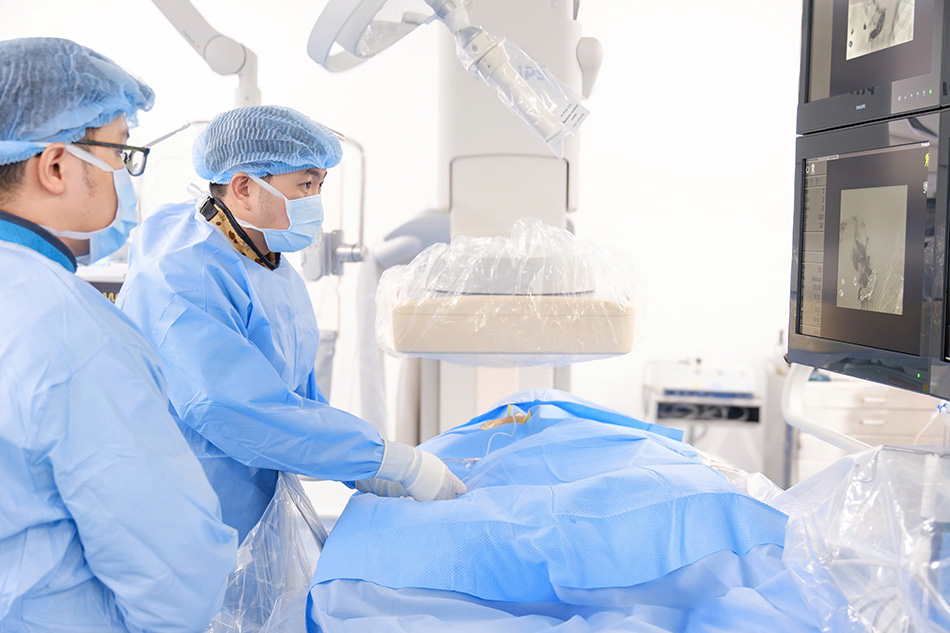
Dr. Huynh Huu Danh uses uterine artery embolisation to treat excessive monthly bleeding caused by uterine fibroids.
The entire treatment took around one hour. The patient remained fully conscious during the surgery, without the need for general anesthesia, and only felt slight pain. Within a day, her monthly blood loss had greatly decreased, her clinical indicators had stabilized, and she was released from the hospital. At her most recent follow-up appointment, her health remained stable, with lighter and more tolerable menstrual cycles.
Uterine Artery Embolization: The Best Treatment Option for Women with Uterine Fibroids
Uterine artery embolisation has been performed at FV Hospital for over a year with excellent results in the treatment of excessive monthly bleeding, extended menstrual bleeding, and irregular uterine bleeding caused by uterine fibroids.
Compared to hysterectomy, uterine artery embolization has numerous benefits in the treatment of uterine fibroids:
- No surgery or general anesthesia necessary.
- Minimal pain with a minimally intrusive method.
- Rapid recovery with same-day discharge is feasible.
- Preservation of the uterus.
- Reduced chance of problems.

Dr. Huynh Huu Danh consults a patient about embolization as an interventional therapy for severe menstrual bleeding.
Dr Danh believes that embolisation is very useful for cases of abnormal vaginal bleeding, such as heavy monthly flow, extended menstruation, and chronic uterine bleeding caused by uterine fibroids. In certain circumstances, uterine artery embolization is used to treat postpartum haemorrhage, allowing for rapid bleeding control.
“We approach the fibroid via the blood arteries and treat it from inside. This strategy helps to alleviate discomfort, lower the risk of complications, and shorten hospital stays. As a consequence, patients save money on their therapy and can return to work and daily life sooner,” Dr Danh stated.
Embolization Procedures Are Covered by National Health Insurance Up to 30 Million VND
At FV Hospital, embolisation procedures are performed in a state-of-the-art catheterisation laboratory that meets international JCI standards for infection control.
FV’s interventional radiology staff is well trained with vast clinical expertise. Dr Huynh Huu Danhhas over ten years of expertise in embolization and interventional treatments and is one of the few experts who can treat both adult and pediatric patients.
Patients having endovascular interventional treatments at FV Hospital are eligible for coverage under Vietnam’s National Health Insurance system, which provides reimbursement of up to 30 million VND. This assistance greatly reduces total treatment expenses for patients.
FV Hospital now offers the following embolisation and interventional procedures:
- Transarterial chemoembolization (TACE) for treating liver cancer
- Uterine artery embolization for uterine fibroids.
- Prostatic arterial embolization
- Embolization is used to treat tumors such as liver, kidney, bone, soft tissue, and vascular tumors, as well as vascular malformations.
- endovascular thrombectomy for acute ischemic stroke.
- endovascular therapy of cerebral aneurysms
- Endovascular therapy for cerebral arteriovenous malformations.
- Embolization for Dural Arteriovenous Fistulas
For more information about uterine artery embolization for uterine fibroids and FV Hospital’s National Health Insurance coverage, readers may visit FV hospital at 06 Nguyen Luong Bang Street, Tan My Ward, Ho Chi Minh City, or call +84 28 3511 3333.