Table of contents
- What is carotid endarterectomy?
- How do I prepare?
- Am I eligible for carotid endarterectomy or carotid angioplasty?
- Screening
- Am I at risk for complications during a carotid endarterectomy?
- What happens during a carotid endarterectomy?
- What can I expect after a carotid endarterectomy?
- Are there any complications?
- Carotid angioplasty
- What can I do to stay healthy?
What is carotid endarterectomy?
Carotid endarterectomy is an operation during which your vascular surgeon removes the inner lining of your carotid artery if it has become thickened or damaged. This procedure eliminates a substance called plaque from your artery and can restore blood flow.
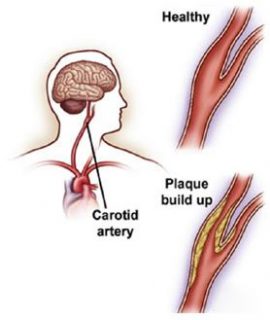
As you age, plaque can build up in the walls of your arteries. Cholesterol, calcium, and fibrous tissue make up this plaque. As more plaque builds up, your arteries narrow and stiffen. This process is called atherosclerosis, or hardening of the arteries. Eventually, enough plaque builds up to reduce blood flow through your carotid arteries, or to cause irregularities in the normally smooth inner walls of the arteries, this is called ‘stenosis’ which is a narrowing of the artery that reduces blood flow to the brain.
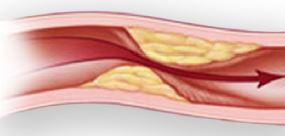
Your carotid arteries are located on each side of your neck and extend from your aorta in your chest to enter the base of your skull. These important arteries supply blood to your brain.
Carotid artery disease is a serious issue because clots can form on the plaque. Plaque or clots can also break loose and travel to the brain. If a clot or plaque blocks the blood flow to your brain sufficiently, it can cause an ischemic stroke, which can cause permanent brain damage, or death, if a large enough area of the brain is affected. If a clot or plaque blocks only a tiny artery in the brain, it may cause a Transient Ischemic Attack (TIA), also known as a mini-stroke. A TIA is often a warning sign that a stroke may occur in the near future, and it should be a signal to seek treatment soon, before a stroke occurs.
To remove plaque in your carotid arteries and help prevent a stroke, your doctor may recommend a carotid endarterectomy. Carotid endarterectomy is one of the most commonly performed vascular operations, and is a safe and long-lasting treatment.
How do I prepare?
Your doctor or vascular surgeon will give you the instructions you need to follow before the surgery, such as fasting.
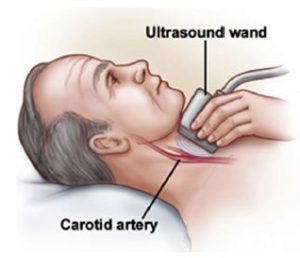
Before your vascular surgeon performs a carotid endarterectomy, he or she may want to determine how much plaque has built up in your arteries. The most common test used for this purpose is Doppler ultrasound. Doppler ultrasound uses painless sound waves to show your blood vessels and measure how fast your blood flows. It can also determine the location and degree of narrowing in your carotid artery. Other tests your vascular surgeon may use include:
- Computed Tomography (CT) scan
- Computed Tomographic Angiogram (CTA)
- Magnetic Resonance Angiography (MRA).
Am I eligible for carotid endarterectomy or carotid angioplasty?
Patients with a stenosis of 60% or more must be operated. Carotid stenosis is asymptomatic so unfortunately the initial symptom is usually an ischemic stroke. This is why screening is essential.
Screening
A non-invasive test called Doppler ultrasound can find out if there is a narrowing (‘stenosis’) of the carotid arteries. All patients with risk factors must be screened once a year by Doppler ultrasound of the carotid and abdominal ultrasound when they are above 50-year old; some patients with severe risk factors should be screened when they are younger.
Risk factors for cardiovascular disease are habits, behaviours, circumstances, or conditions that increase a person’s risk of developing cardiovascular disease. They include:
- Lack of exercise
- Smoking
- Diabetes
- High blood pressure (hypertension)
- Being overweight
- Dyslipidaemia such as high LDL cholesterol (‘bad’ cholesterol)
- Unhealthy eating habits (night-time noshing, endless snacking, junk food, excess of salt, saturated fat, and sugar)
- Previous myocardial infarction
- Age over 50 for men and 60 for women
- Family history
- Ethnicity (non-Hispanic black > non-Hispanic white > Asian).
Am I at risk for complications during a carotid endarterectomy?
Having had a stroke in the past increases your chances for complications to a varying degree depending upon its severity, how recently it occurred, and the degree of recovery. Other factors that may increase your chances for problems during a carotid endarterectomy, in addition to those conditions listed above, include:
- The presence of a serious disease, such as severe heart or lung disease
- Plaque your surgeon cannot reach through surgery
- Severe blockage in other blood vessels that supply blood to your brain, such as the carotid artery on the other side
- Having a new blockage in a previous carotid endarterectomy on the same side (recurrence)
- Diabetes.
What happens during a carotid endarterectomy?
You may either be put to sleep or, alternatively, your anesthesiologist or surgeon can numb your neck area and keep you awake so you can communicate with the surgeon during the operation. By staying awake, you may help your doctor monitor your brain’s reaction to the decreased blood supply. Once you are either asleep or the area around your neck is completely numb, your surgeon will shave the skin on your neck where he or she is going to make an incision, to help prevent infections. Your surgeon then makes the incision on one side of your neck to expose your blocked carotid artery. Next, your surgeon temporarily clamps your carotid artery to stop blood from flowing through it. During the procedure, your brain receives blood from the carotid artery on the other side of your neck. Alternatively, your surgeon can insert a shunt to detour the blood around the artery that is being repaired.
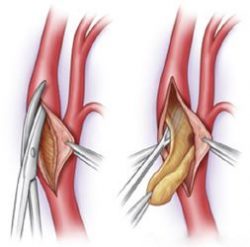
After your surgeon clamps your carotid artery, he or she makes an incision directly into the blocked section. Next, your surgeon peels out the plaque deposit by removing the inner lining of the diseased section of your artery containing the plaque. After removing the plaque, your surgeon stitches your artery, removes the clamps or the bypass, and stops any bleeding. He or she then closes your neck incision and the procedure is complete. Often, a patch is used to widen the artery as part of the procedure. The patch material used can be your own vein, usually from the leg, or a variety of synthetic materials depending upon your particular circumstance. The procedure takes about 2 hours to perform but may seem slightly longer depending upon the anaesthetic and preparation time.
What can I expect after a carotid endarterectomy?
After surgery, you may stay in the hospital for 1 to 2 days. During this time, your doctor will monitor your progress. Initially, during your recovery, you will receive fluid and nutrients through a small, thin tube called an intravenous (IV) catheter. Because the neck incision is so small, you may not feel significant pain.
After you go home, your doctor may recommend that you avoid driving and limit physical activities for several weeks. You can usually begin normal activities again several weeks after the operation.
If you notice any change in brain function, severe headaches, or swelling in your neck, you should contact your doctor immediately.
Are there any complications?
You may have complications following any surgical procedure. A stroke is one possible complication following a carotid endarterectomy. This risk is very low, ranging between 1 and 3 percent. Another unusual complication is the re-blockage of the carotid artery, called restenosis, which may occur later, especially if you continue to smoke cigarettes. The chance of developing a restenosis severe enough to require another carotid endarterectomy is usually about 2 to 3 percent.
Temporary nerve injury, leading to hoarseness, difficulty with swallowing, or numbness in your face or tongue, is another uncommon, but possible, complication. This usually clears up in less than 1 month and usually doesn’t require any treatment. However, the chance of any of these unusual complications is much less than the risk of stroke if a significant carotid blockage is not adequately treated.
Carotid angioplasty
During carotid angioplasty (also called carotid artery stenting), a small, expandable tube called a stent is permanently inserted into the carotid artery.
To insert the stent, the doctor uses another tube called a catheter. The doctor inserts the catheter into a large artery, most often the femoral artery in the groin, and threads it through other arteries to the carotid artery.
A very thin guide wire is inside the catheter. The guide wire is used to move a balloon and the stent into the carotid artery. The balloon is placed inside the stent and inflated. This opens the stent and pushes it into place against the artery wall. The balloon is then deflated and removed, leaving the stent in place. After time, the cells lining the blood vessel will grow through and around the stent to help hold it in place.
What can I do to stay healthy?
Although a carotid endarterectomy or a carotid angioplasty can reduce your risk of stroke by removing the offending plaque, and although the procedure is quite durable, it does not completely stop plaque from building up again in susceptible individuals. To minimise the chance of hardening of the arteries occurring again, you should consider the following changes:
- Eat foods low in saturated fat, cholesterol, and calories
- Exercise regularly, especially aerobic exercises such as walking
- Maintain your ideal body weight
- Avoid smoking
- Discuss cholesterol-lowering medications and antiplatelet therapy with your doctor.