The robotic partial nephrectomy at FV Hospital was completed in under 2 hours and the warm ischaemia time was controlled at 18 minutes, which is well within the internationally recommended threshold. This enabled the patient to recover swiftly: walking independently the following day and discharged just 48 hours after surgery.
The incidental discovery of a kidney tumour during a routine check-up
During a routine health screening in early March 2026, Ms P.T. Diem Le (HCMC) was shocked to learn of a tumour in her left kidney. What made the finding all the more unsettling was that a health check just four months earlier had returned entirely normal results.
“I was quite shocked when I received the ultrasound result. Fortunately, having a family member in medicine, I was able to compose myself fairly quickly and focus on finding the best possible treatment,” she said.
After thorough research, the patient and her family decided to seek treatment at FV Hospital.
Dr Do Quang Minh, MSc, Head of Urology Department at FV Hospital, diagnosed a 3.4cm tumour in the left kidney, classified as stage T1a. She was indicated for partial nephrectomy, the gold standard approach for kidney-preserving surgery in early-stage cases.
“Our plan was to excise the tumour completely and then reconstruct the remaining renal tissue. The critical challenge is to perform the resection as swiftly and precisely as possible, since excision of the tumour requires the temporary interruption of the renal blood supply. If this is prolonged, renal tubular cells begin to sustain irreversible damage,” Dr Minh explained.
To optimise the clinical outcome and offer the patient the least invasive possible experience, the surgical team elected to perform the procedure using the da Vinci Xi robotic system – a technology that significantly enhances precision and the capacity for nephron preservation.
Tumour resected and kidney preserved: patient ambulant within 24 hours of procedure
On the afternoon of March 25, the surgical team led by Dr Do Quang Minh successfully completed the robotic partial nephrectomy using the da Vinci Xi system. The procedure was performed under the observation of French robotic urology specialist Dr Jean-Luc Hoepffner of the Groupe Urologie Saint Augustin.
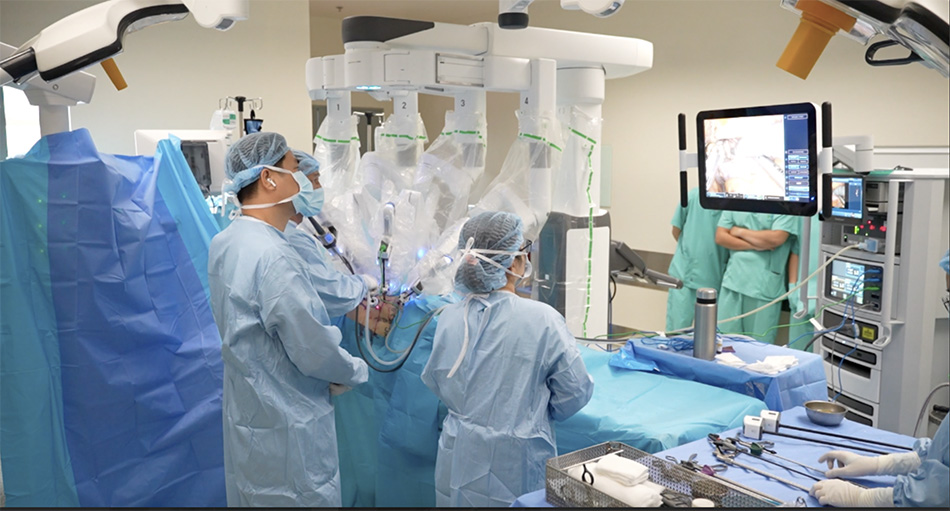
The FV Urology team performing robotic partial nephrectomy using the da Vinci Xi system.
The operation was completed in under two hours. With robotic arms capable of 540-degree articulation, the surgeon was able to access the tumour from multiple complex angles with exceptional dexterity. Most notably, the FV team set an internal target of 18 minutes for the warm ischaemia period – well within the internationally recommended threshold of 30 minutes. This ensured the highest possible degree of safety for the patient.
“The robotic system allows us to access anatomical positions that conventional laparoscopy struggles to reach. The suturing and vascular clamping are both significantly faster and more precise,” Dr Minh said.
The very next morning, Ms Le was walking independently, eating normally, and carrying out her daily activities without difficulty.
“What surprised me most was how gentle the whole experience was. It was far less painful than I had imagined,” she said.
Subsequent histopathological analysis confirmed the tumour to be malignant. However, the resection had achieved clear, and no requirement for adjuvant treatment. The patient was discharged just two days after surgery.
Her family noted that FV coordinated the combined benefits of the national’s social insurance programme and her private health insurance simultaneously, an arrangement that resulted in her procedure being covered in full.
“From my own experience, I would encourage everyone to attend their routine health checks. Early detection really does make all the difference,” Ms Le said.
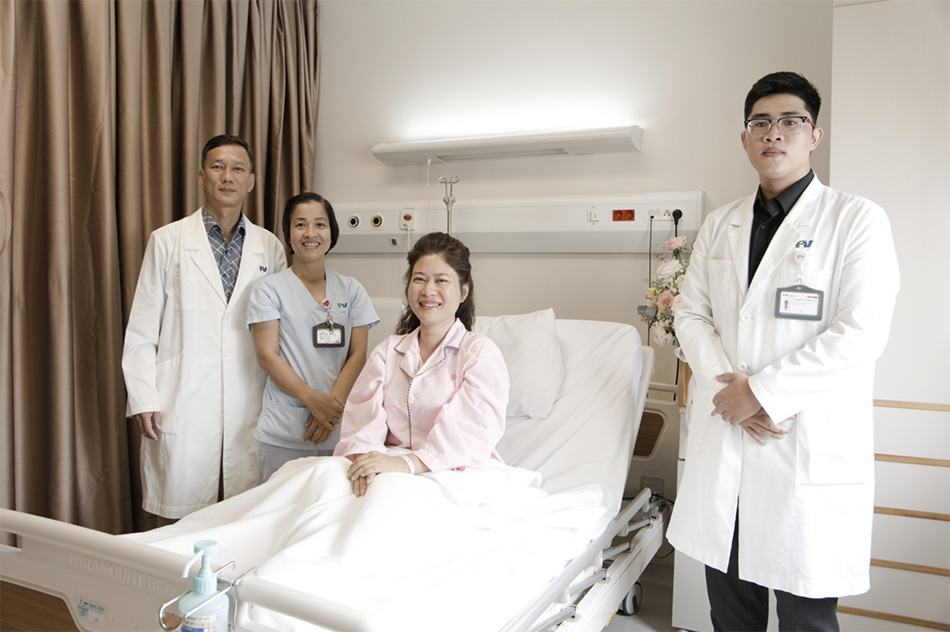
Ms Le with Dr Minh (far left) and the Urology team.
Robotic-assisted technology setting a new standard in urological surgery
The rapid advancement of robotic surgical technology is opening a new chapter in urological surgery, one of the most technically demanding disciplines in the surgical field.
According to Dr Do Quang Minh, robotic assistance is now applied across the full spectrum of urological procedures: radical and partial nephrectomy, nephroureterectomy with bladder cuff excision, radical cystectomy, radical prostatectomy, and lymph node dissection for oncological staging.
Even complex cases that previously required open surgery, such as advanced renal tumours with venous invasion or large bladder tumours, can now be performed robotically. The clinical advantages of robotic-assisted minimally invasive urological surgery are well established:
- Superior visualisation: High-definition 3D imagery with up to 10x magnification allows surgeons to see anatomical structures more clearly than the naked eye.
- Enhanced dexterity: The robotic EndoWrist instruments offer a range of motion greater than the human hand, allowing for effective operation in the narrow, confined spaces that are particularly challenging to access via standard laparoscopy.
- Optimal stability: The system automatically filters out natural hand tremors, enabling fine, stable operative movements that minimise collateral injury to healthy tissue and maximise the precision of nephron-sparing techniques. In urological surgery in particular, the ability to perform rapid and precise suturing while the blood supply is clamped is vital. This reduces blood loss and protects the functional integrity of the healthy kidney tissue.
Dr Jean-Luc Hoepffner, a specialist with over 3,000 robotic procedures to his name, highlighted the technology’s significance: “In the past, removing prostate or kidney tumours often carried risks of functional complications, such as urinary incontinence and erectile dysfunction. With robotic assistance, we can preserve surrounding tissues and nerves with far greater precision, significantly improving both oncological safety and quality of life compared with open surgery.”
Dr Hoepffner also praised the proficiency of the FV team: “Dr Minh is a highly experienced surgeon who maintains excellent control over the entire procedure. I was particularly impressed by the seamless coordination of the FV surgical team, which operates to world-class standards.”
For more information or to book a consultation regarding robotic urological surgery using the da Vinci Xi system, please contact the Urology Department at FV Hospital, 6 Nguyen Luong Bang Street, Tan My Ward (formerly District 7), Ho Chi Minh City. Tel: (028) 3511 3333.