FV Hospital has recently integrated a sophisticated technique into its oncological surgical repertoire: “Sentinel Lymph Node Biopsy (SLNB) using Indocyanine Green (ICG) fluorescence”. This success enables FV to be more proactive in breast cancer treatment while confirming the hospital’s position in continuously applying advanced medical technology, providing opportunities for breast-conserving surgery and improving the quality of life for Vietnamese patients.
Sentinel lymph node biopsy using ICG: A safer approach for breast cancer patients
Sentinel lymph node biopsy using ICG is a modern technique that enables precise identification of metastatic lymph nodes without the use of radioactive substances. It is particularly effective in complex cases involving patients who have undergone neoadjuvant chemotherapy. Recently, FV Hospital’s surgeons successfully performed this technique during an operation on a 29-year-old female patient diagnosed with breast cancer.
The patient was admitted with a diagnosis of advanced-stage right breast cancer. After completing neoadjuvant chemotherapy (NAC), the axillary lymph nodes previously suspected of involvement responded well and were no longer clinically suspicious. This situation required a precise surgical plan. If the correct sentinel node is not identified, the patient may undergo unnecessary axillary node clearance, or there is a risk of missing lymph node assessment.
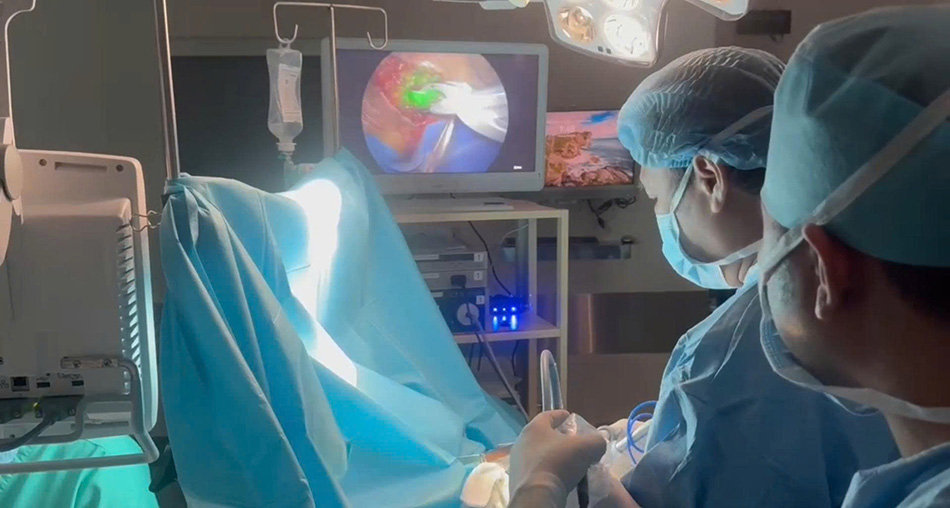
Following consultation with the multidisciplinary team of the Tumour Board and Dr Basma M’Barek (Head of the Hy Vọng Cancer Care Centre), a breakthrough treatment plan was approved. It used a dual-marker approach using Methylene Blue combined with ICG fluorescence to ensure maximum accuracy and safety.
The surgery proceeded smoothly through the seamless coordination between surgeons from the FV Hospital’s Breast Health Care Centre and the operating theatre team. They simultaneously performed, in a single anaesthetic, sentinel lymph node biopsy, partial mastectomy, and breast reconstruction using a latissimus dorsi (LD) flap. The retrieved nodes were examined and confirmed to be negative for metastasis, allowing the patient to avoid axillary lymph node dissection.This new application helped the surgical team achieve three primary goals: tumour removal, aesthetic preservation, and increased safety by using ICG instead of conventional tracers.
Distinct advantages of ICG in sentinel lymph node biopsy for breast cancer treatment
In breast cancer treatment, axillary lymph nodes act as the first “guard stations” where cancer cells tend to invade. Previously, doctors often had to perform a full axillary lymph node clearance to ensure safety, which could lead to lymphedema—a complication causing the arm to swell, become painful, and suffer permanent mobility restriction
Sentinel lymph node biopsy (SLNB) represents a landmark advancement: surgeons identify and remove only the first lymph nodes most at risk of metastasis. If these nodes are clear, the remaining lymph nodes are left intact, fully preserving arm function for the patient.
Historically, this technique relied on blue dye (Methylene Blue), radioactive Technetium, or a combination of both as tracers.
In cases where breast cancer patients have axillary lymph node metastasis at the time of diagnosis and undergo neoadjuvant chemotherapy (NAC), many nodes may convert to negative after treatment. This allows patients to potentially avoid axillary lymph node dissection during subsequent surgery. Surgeons must confirm this conversion through Sentinel Lymph Node Biopsy (SLNB). However, the criteria in these instances are more stringent: dual tracers (two simultaneous detection techniques) must be used, and at least three nodes must be identified and confirmed as non-metastatic.
As mentioned above, the dual-tracer technique typically involves a blue dye (Methylene Blue) combined with radiopharmaceuticals. However, radioisotope techniques may have certain drawbacks, such as high costs, radiation exposure, and limited availability of radioactive sources. In such cases, ICG serves as an excellent alternative.
Currently in Vietnam, few centers are fully equipped with all detection technologies (dye and radioisotopes). FV Hospital stands out as a facility that offers a comprehensive range of detection techniques, including dye, radioisotopes, and ICG.
Once injected, ICG fluoresces under a specialized camera, acting as a visual ‘light map’ that allows surgeons to clearly see the lymphatic system on the surgical monitor.
Compared to traditional methods, ICG offers the following advantages:
- Patient safety: ICG is non-radioactive, completely eliminating any risk of radiation exposure for both the patient and the surgical team.
- Streamlined Procedure: The process does not require bulky Gamma probes, making the surgery faster, less invasive, and more cost-effective for the patient.
World-class medical ecosystem at FV: delivering superior outcomes in cancer treatment
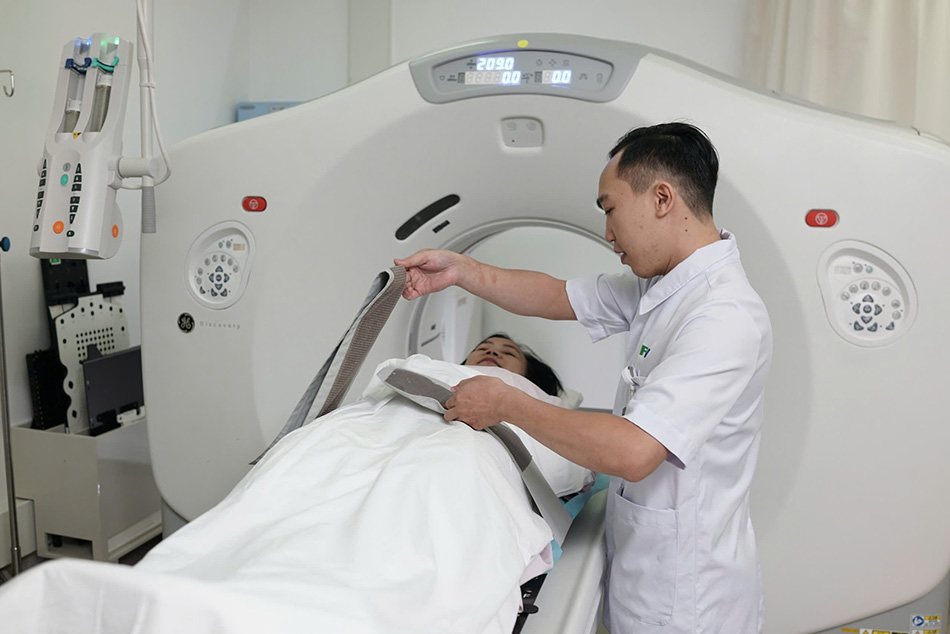
This recent breast cancer case is one of many testaments to the power of multi-disciplinary collaboration, establishing FV as a leading and trusted destination for cancer treatment.
- Multidisciplinary Tumor Board decisions: At FV, no treatment decision is made in isolation. Every oncology case is meticulously discussed among surgeons, oncologists, radiologists, and related specialists. This close collaboration provides a comprehensive professional perspective to determine the best protocol for each individual case.
- Leading medical technologies in Vietnam: Very few healthcare facilities in Vietnam have the capability to perform ICG-guided SLNB. FV is also a pioneer in Vietnam in adopting many of the world’s most advanced oncological treatment techniques, including TBI, SBRT, SRS, IMRT, and VMAT, with plans to introduce CyberKnife S7, the world’s only robotic radiosurgery system capable of treating tumours at any location in the body without the need for surgery.
- A focus on comprehensive treatment and patient support: At FV, the focus extends beyond tumour elimination. The hospital prioritises the restoration of quality of life and patient confidence. Combining radical treatment with aesthetic reconstruction in a single procedure reduces the number of surgeries required, aiding both physical and mental recovery. FV’s cancer treatment programmes also involve nutritionists, psychologists, physiotherapists, pain management specialists, and other allied health professionals, providing patients with comprehensive support throughout their cancer journey.
FV Hospital continually strives to bring the latest global medical advances to Vietnam, ensuring that every patient facing cancer has access to gentler treatment, faster recovery, and the greatest possible opportunity for organ-preserving solutions. Through significant investment in both technology and personnel, FV Hospital continues to affirm its commitment to providing JCI-standard medical services, where patients are cared for with deep understanding and the most advanced medical solutions.