



Although the two front teeth arrived at the hospital after the “golden hour” had passed, FV’s Maxillofacial and Dental Surgery team successfully saved and replanted them for the 16-year-old patient.
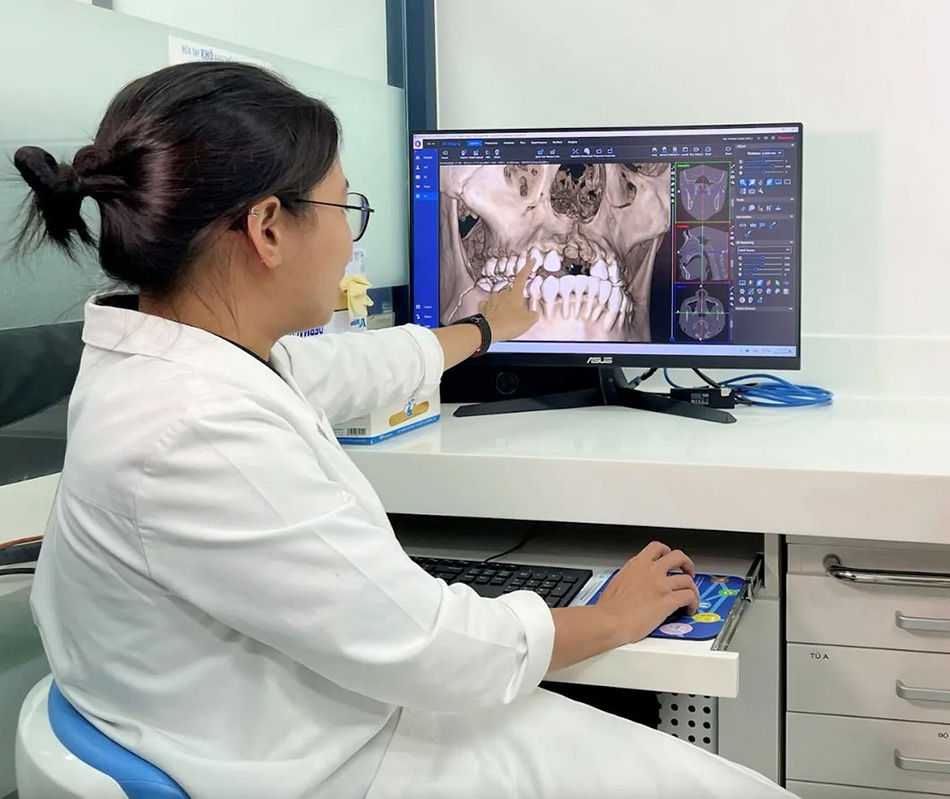
3D scan showing the patient’s jaw injuries. Photo: FV
An unusual situation: The patient arrived first, the teeth later
Late one afternoon, the Accident & Emergency Department at FV Hospital received N.T.L., a 16-year-old boy who had sustained multiple injuries in a traffic accident. He had received first aid and temporary dressings for injuries to his head, arms and legs at another hospital before being transferred to FV for the management of complex maxillofacial injuries.
Dr Trinh Van Hai, Head of the Accident & Emergency Department at FV Hospital, recalled: “The patient arrived with bleeding from his head, nose and mouth, as well as multiple injuries across his body. When I asked him to open his mouth, both upper front teeth were completely missing. The tooth sockets were severely damaged and still bleeding. His father, who was standing nearby, was in complete shock.”
The doctors immediately activated the multidisciplinary coordination process. Dr Nguyen Thanh Tung, PhD, Head of Maxillo and Dental Surgery, attended the Accident & Emergency Department immediately for consultation. To rule out potentially serious injuries, the patient was quickly taken for a CT scan.
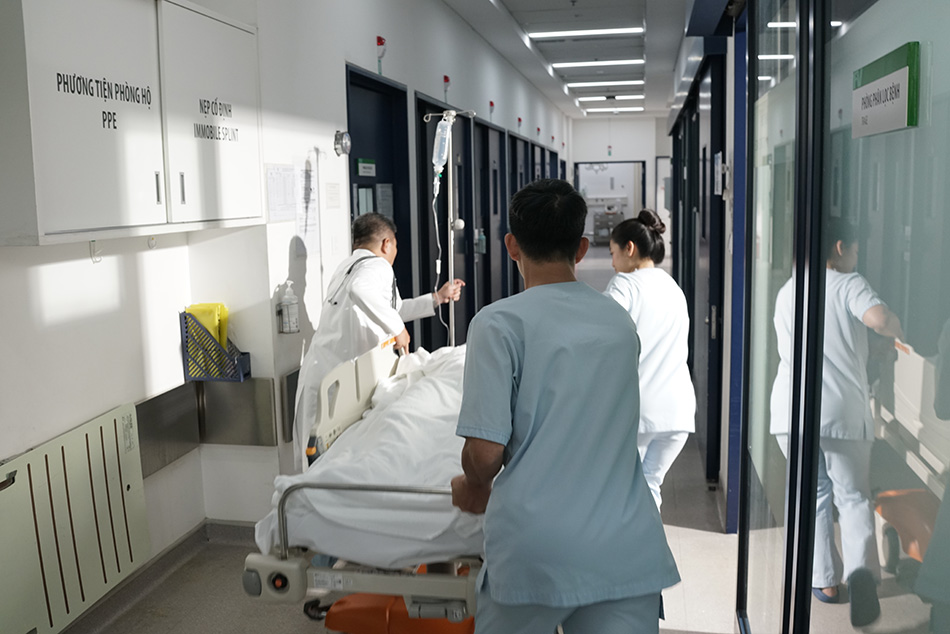
Doctors at the Accident & Emergency Department receiving the traffic accident patient. Photo: FV
While the patient was in the CT room, his relatives hurriedly brought the two front teeth to the emergency department. They were wrapped in a piece of dry tissue and covered in dirt from the accident. Understanding that every passing minute reduces the survival chances of the cells around the tooth roots, the emergency team immediately transferred the two teeth to the Maxillofacial and Dental Surgery Department.
One team treats the patient while another races to save the teeth
Under the guidance of Dr Tung, Dr Nguyen Thi Minh Khue and her colleagues from the Maxillofacial and Dental Surgery Department immediately began treatment for the two teeth that had just arrived. They cleaned off the dirt using a specialised solution, assessed the damage, and prepared a plan to replant the teeth.
“We did not wait for the patient to be transferred to our department before treating the teeth. Every step that could be completed in advance was carried out immediately to save time,” Dr Khue said.
According to Dr Nguyen Thi Minh Khue, the biggest challenge was that the two teeth had been outside the body for about two hours, exceeding the recommended 60-minute – “golden hour” for tooth replantation. Furthermore, the teeth were wrapped in dry tissue, increasing the risk of damage to, or death of, the cells surrounding the tooth roots.
At 16 years old, losing two front teeth not only affects chewing, speech, and appearance but also impacts the development of the jawbone. Meanwhile, alternative treatments such as dental implants are not the optimal option. “Natural teeth are always the best choice,” Dr Khue added.
Another complication was that the patient also suffered damage and deformity to the alveolar bone area (the tooth socket bone). Therefore, the doctors needed to reconstruct the socket structure before replanting the teeth into their original positions. This difficult step took nearly an hour, while replanting and stabilising the two teeth took only about 15 minutes.
Afterwards, the patient was transferred back to the Accident & Emergency Department to continue treatment for extensive soft tissue wounds on his face and body. The nursing team cleaned the road-rash injuries to minimise the risk of infection and severe scarring.
After more than 3 months and 7 follow-up visits, the two teeth that had once been knocked out of the jaw are now firmly reattached in the bone socket, ensuring proper chewing, speech, and appearance. T.L. will continue to be monitored by FV doctors at the 6-month and 12-month marks to detect any delayed complications at an early stage, if they arise.
“Today’s outcome is not due to a single technique, but to rapid coordination between departments, timely preparation, and the determination not to give up on saving the natural teeth for a very young patient,” Dr Khue shared.
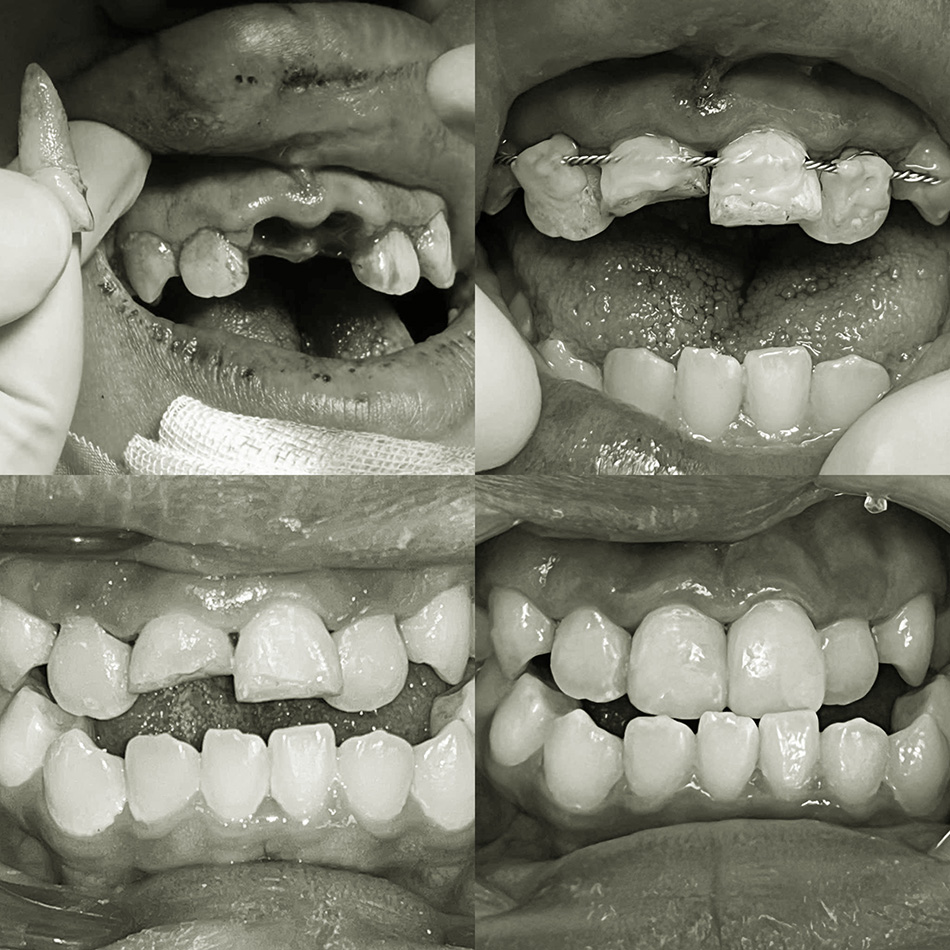
The patient’s teeth at the time of the accident (top 2 photos) and 3 months after the replantation (bottom 2 photos). Photo: FV
A “life-saving” first-aid lesson on how to save a knocked-out tooth
Traffic accidents and other injuries that cause teeth to be knocked out are not uncommon. However, many people lose the opportunity to save their teeth because appropriate first aid is not provided immediately after the injury.
Dr Nguyen Thanh Tung emphasised: “No matter how experienced the doctor or how advanced the hospital facilities may be, if the tooth is not preserved correctly from the very beginning, the chances of saving it drop significantly.”
According to Dr Tung, when a tooth is knocked out, you should:
- Only hold the crown (the visible part) of the tooth and absolutely never touch the root.
- If the tooth is dirty, only rinse it gently under running water; do not scrub it.
- Do not wrap the tooth in tissue or cotton wool, and do not leave it to dry in the air. It is best to preserve the tooth in unsweetened fresh milk or in the patient’s own saliva.
- Get the patient to a medical facility with maxillofacial and dental care as soon as possible, ideally within 60 minutes of the accident, with treatment within the first 15 minutes offering the best chance of success.
“The less time the tooth remains outside the body and the more appropriate the preservation environment, the higher the chance of saving the natural tooth,” Dr Nguyen Thanh Tung advised.
For more information about maxillofacial and dental trauma treatment at FV Hospital, readers can visit 06 Nguyen Luong Bang, Tan My Ward, Ho Chi Minh City, or contact the hotline on (028) 35 11 33 33.
Related News
See moreRelated News
How 10 dental implants changed one patient’s life at FV Hospital
After years of tooth loss led to severe jawbone resorption and difficulty eating, specialists at FV Hospital restored the patient’s smile by placing 10 dental implants in one procedure. How years of tooth loss lead to jawbone loss For many years, Mr Lam Quang Kieu Phong (55, Ho Chi Minh City) experienced tooth loss. Some […]
Two Vietnamese midwives attain international IBCLC certification in breastfeeding counselling
Two midwives from FV Thomson’s Maternity Department have earned IBCLC (International Board Certified Lactation Consultant) certification, the international credential for breastfeeding support specialists. This achievement represents a significant clinical milestone in infant feeding support at FV Hospital, driven by the real-world complexities these practitioners encounter daily when supporting mothers and their newborns. Beyond certification: A […]
FV Hospital Celebrates International Allied Health Professions Day 2026
On 14 October 2026, FV Hospital held a special event to express its appreciation for allied health professionals. Attendees included members of the Board of Directors, heads of departments, and more than 40 allied health professionals and specialists. The event recognised the dedication of allied health professionals across a range of specialties, including Dietetics and […]
FV pioneers ERAS® implementation in Vietnam in line with international standards, supporting faster postoperative recovery
FV Hospital has become the first hospital in Vietnam to partner with Sweden-based Encare AB to implement the Enhanced Recovery After Surgery (ERAS®) programme. Through this partnership, FV joins Encare’s network of 22 hospitals in 11 countries across the Asia-Pacific region. The initiative aims to standardise surgical care according to international guidelines, leverage data to […]
How 10 dental implants changed one patient’s life at FV Hospital
Two Vietnamese midwives attain international IBCLC certification in breastfeeding counselling
FV Hospital Celebrates International Allied Health Professions Day 2026

