




A Cambodian patient with oesophageal cancer recently had a successful robotic oesophagectomy using the da Vinci Xi system at FV Hospital. After the six-hour surgery, he was surprised to feel almost no pain and could not even tell where the operation had been done on his body.
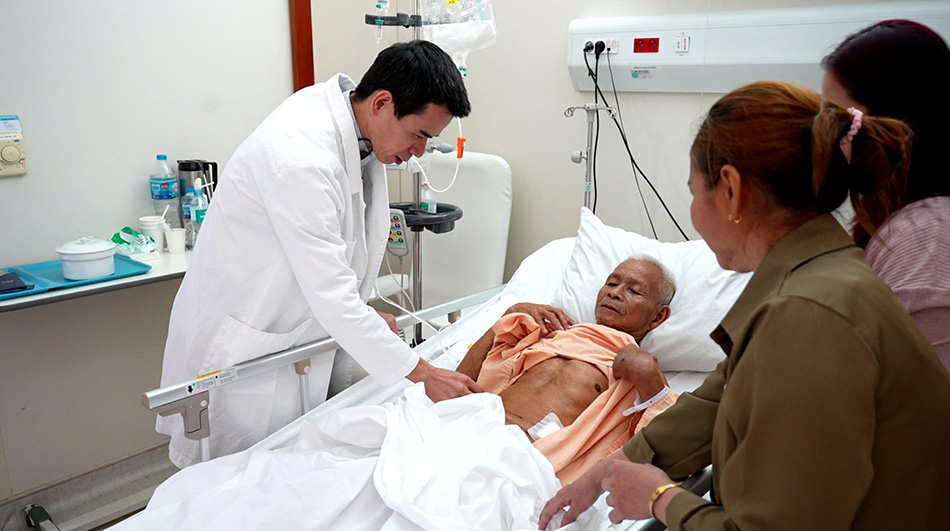
Patient and his family express their gratitude to Dr Doan Ngoc Giao, PhD, and the FV Hospital medical team.
A large oesophageal tumour causing progressive swallowing difficulty
Mr Oung Voeun, a Cambodian born in 1953, came to FV Hospital after months of worsening difficulty swallowing. This problem had caused his overall health to decline significantly.
“Even eating congee or drinking water had become impossible without choking. The sound of my voice had become hoarse and I could no longer speak as clearly as before,” Mr Voeun recalled.
After an endoscopy and other clinical tests, Dr Doan Ngoc Giao, PhD – a gastrointestinal surgery specialist at FV da Vinci Robotic Surgery Centre – found a large tumour in the middle part of the oesophagus. Imaging also showed signs of enlarged lymph nodes surrounding the tumour.
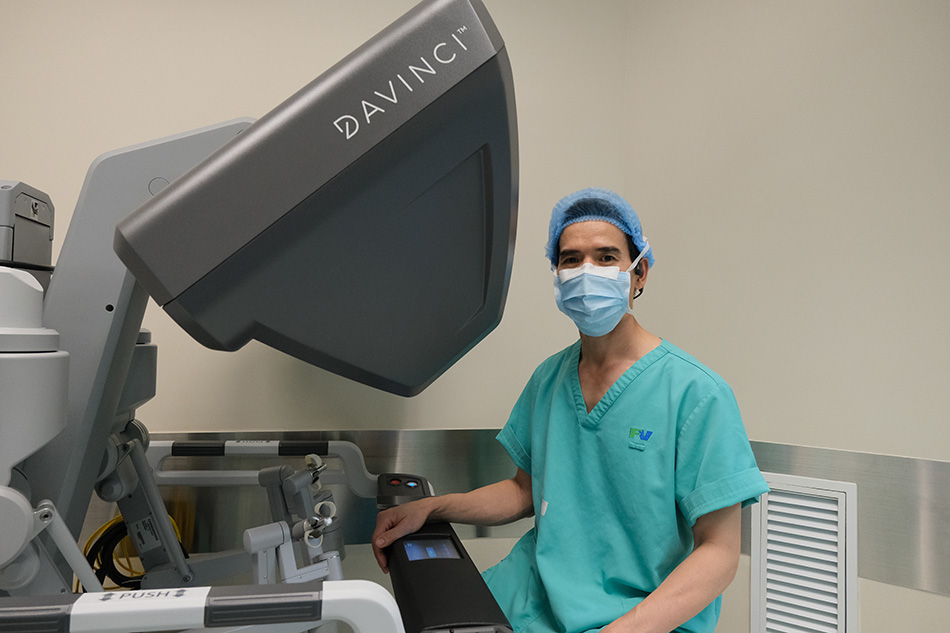
Dr Doan Ngoc Giao, PhD, at the da Vinci robotic surgical console during the oesophagectomy for patient Oung Voeun.
After a multidisciplinary case conference, especially with input from the Oncology team, the doctors recommended neoadjuvant concurrent chemoradiotherapy. This treatment combines chemotherapy and radiotherapy before surgery. After three cycles of chemoradiotherapy and over three months of monitoring, new scans showed the tumour had shrunk significantly in size and the enlarged lymph nodes had almost disappeared. This was considered the appropriate time to proceed with curative surgery.
Dr Doan Ngoc Giao, PhD, explained that this case was especially challenging not just because of the tumour, but also due to the patient’s history of severe chest injuries from many years ago. He had suffered multiple rib fractures, lung bruising, and bleeding in the chest. These injuries left heavy scarring, with fibrous tissue sticking organs and tissues together and changing the normal anatomy.
“The patient’s pleural space had been completely closed off by fibrous adhesions, which was a direct result of his earlier injuries. There was no natural working space left, and none of the usual anatomical landmarks were visible. We had to carefully remove all the adhesions and dissect the pleura, which means stripping away the fibrous layer around the lung, and work through the distorted anatomy left by the trauma, step by step,” Dr Doan Ngoc Giao explained.
From the very first incision, the surgical team faced a much more difficult environment than usual. Most of the normal anatomical landmarks were gone, and there was constant bleeding from the areas where adhesions had been removed. The oesophagus is also very close to other important structures in the chest.
Besides removing the tumour, the team had to carefully work through dense scar tissue while keeping all nearby organs safe.
The da Vinci Xi system: rising to the challenge of a complex operation
Given these challenges, the surgical team chose the Da Vinci Xi robotic surgical system as recommended robotic surgery using the da Vinci Xi system. Dr Doan Ngoc Giao said this case clearly shows how the robotic system excels in complex gastrointestinal surgery.
When previous injuries have changed the internal anatomy, surgery requires extremely high precision to avoid harming nearby vital structures. The da Vinci Xi’s high-definition 3D imaging helped the surgeon see tissue layers clearly and find difficult areas of scar tissue in the chest. The robotic arms allowed for steady, fine movements in tight spaces, making it possible to use microsurgical techniques with great accuracy and efficiency.
“In complex conditions such as oesophageal cancer, and particularly in the most technically demanding cases, the robotic system provides an exceptional level of support to the surgeon throughout the procedure,” said Dr Doan Ngoc Giao, PhD.
After more than six hours in the operating theatre, the team successfully finished the oesophagectomy, worked through all the areas of dense scar tissue, and completed the planned removal of lymph nodes in the chest.
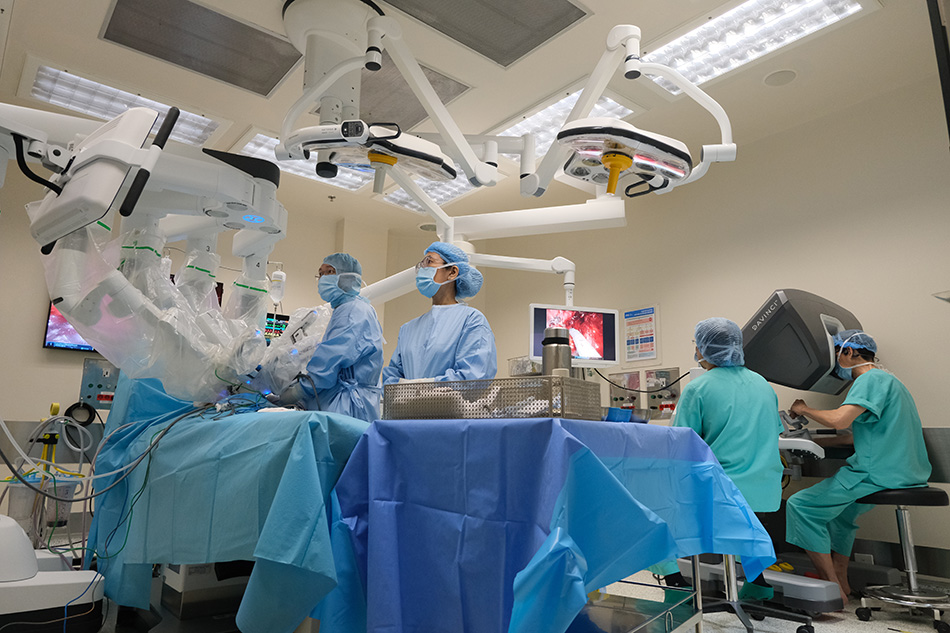
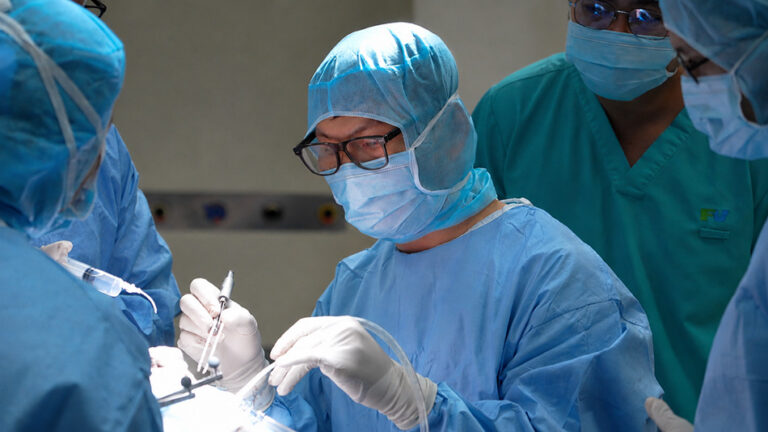
FV Hospital surgical team performing robotic oesophagectomy using the da Vinci Xi system.
A positive recovery: discharged in six days, unable to find the incisions
After surgery, Mr Voeun was most surprised by how different the experience was from what he had expected.
“When I woke up after the operation, I experienced nearly no pain at all. I couldn’t even tell where they had operated on me. I looked and looked, but I couldn’t find the incisions,” the patient shared.
Dr Doan Ngoc Giao, PhD, reported that by the sixth day after surgery, Mr Voeun was recovering very well.
“The patient is alert and orientated, in good general health, communicating normally, eating and drinking normally, and managing all activities without difficulty,” the doctor confirmed.
In addition to being happy with the results of his treatment, Mr Oung Voeun praised the care he received at FV Hospital: “The doctors, nurses, and all the healthcare staff looked after me with great dedication and attentiveness. Whenever I needed anything, I only had to press the call button and someone was with me immediately.”
As robotic surgery continues to advance, it is offering more treatment options for complex conditions that require the highest level of precision. This technology not only improves surgical accuracy but also supports postoperative recovery and brings real, practical benefits.
For more information about robotic surgery for oesophageal cancer, please contact FV Hospital at 6 Nguyen Luong Bang Street, Tan My Ward (formerly District 7), Ho Chi Minh City. Hotline: (028) 3511 3333.
Related News
See moreRelated News
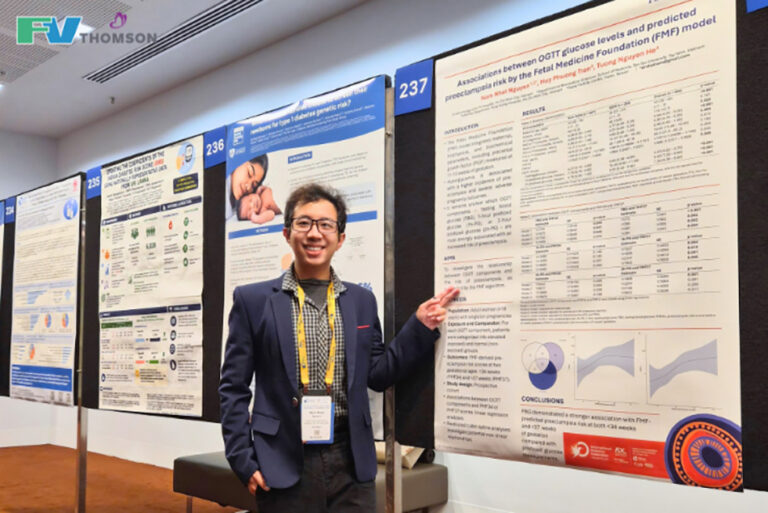
Dr Nguyen Nhat Nam, PhD – Head of the Endocrinology Unit at FV Hospital, presents his research at the International Diabetes Federation (IDF) Congress 2026
From 18 to 21 August 2026, Dr Nguyen Nhat Nam, PhD, Head of the Endocrinology Unit at FV Hospital, attended and presented a scientific research paper titled “The association between glucose tolerance test values and predictive models for pre-eclampsia risk in pregnant women” at the International Diabetes Federation (IDF) Congress 2026, held in Melbourne, Australia. […]
Patient Safety Week 2026 at FV connects healthcare professionals and promotes a culture of safety
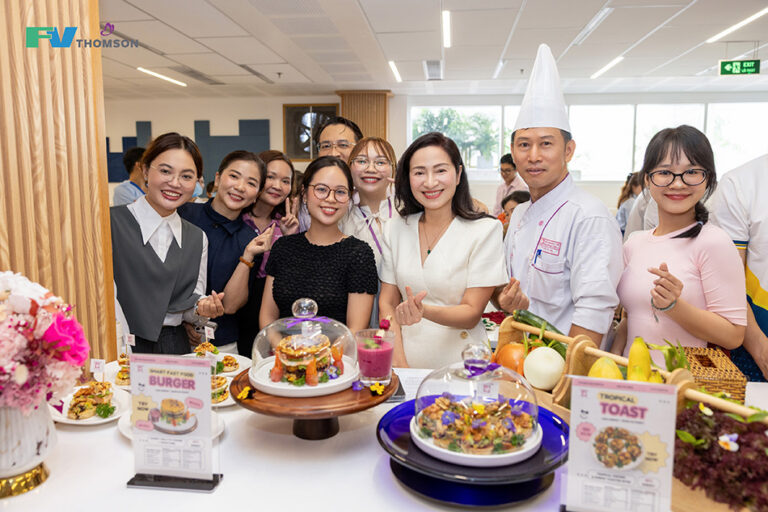
From 14 to 18 September 2026, FV Hospital held Patient Safety Week 2026 in support of World Patient Safety Day organised by the World Health Organization (WHO), under the theme “Safe care for noncommunicable diseases” and the message “Safe care for life!”. Patient Safety Week 2026 at FV took place from 14–18 September, featuring a […]
Travelling halfway across the world for specialist spinal stenosis treatment
A Canadian woman who had nearly lost the ability to walk due to spinal canal stenosis was successfully treated at FV Hospital and was able to return home just one week after surgery. More than thirty years ago, Ms M.C. (49, Canada) underwent scoliosis correction surgery. In the past year, she developed severe back pain […]
Join FV Hospital’s 16th “Give Blood – Give Hope” Blood Donation Programme
On 25 September 2026, FV Hospital will continue its collaboration with Blood Transfusion Haematology Hospital to organise the 16th “Give Blood – Give Hope” blood donation programme. Programme details: Eligibility criteria: Donor benefits: Each donor will receive a thank-you gift from the programme, including: Registration guidelines: FV Hospital warmly invites all eligible guests to take […]
Dr Nguyen Nhat Nam, PhD – Head of the Endocrinology Unit at FV Hospital, presents his research at the International Diabetes Federation (IDF) Congress 2026
Patient Safety Week 2026 at FV connects healthcare professionals and promotes a culture of safety
Travelling halfway across the world for specialist spinal stenosis treatment

