



Advances in radiotherapy and targeted drug treatments are giving people with breast cancer more treatment options, helping to reduce the burden of prolonged treatment and, in suitable cases, improve the chances of preserving the breast rather than undergoing a mastectomy. These advances can improve disease control and increase the chances of breast preservation in suitable cases.
Next-generation radiotherapy: shorter treatment courses with greater protection for healthy tissue

Dr Bui Le Phuoc Thu Thao, Specialist Level II, discusses treatment options for a patient with breast cancer. (Photo: FV Hospital)
In breast cancer radiotherapy, technical and technological advances in recent years have transformed the way doctors treat the disease. Dr Bui Le Phuoc Thu Thao, Specialist Level II and Head of the Hy Vong Cancer Centre at FV Hospital, explains: “The biggest shift is that we can now deliver radiation more precisely, over fewer days, and with less impact on patients.”
Radiotherapy courses that previously lasted 5–6 weeks can now be completed in around 3 weeks or, in selected cases, as little as 1 week. For left-sided breast cancer, the deep inspiration breath-hold (DIBH) technique helps move the heart away from the radiation field, reducing radiation exposure to the heart and lungs.
Before treatment, patients undergo a CT scan to create a three-dimensional map of the treatment area. Doctors work closely with medical physicists to plan the radiation dose and beam angles, aiming to deliver the prescribed dose to the target while minimising exposure to surrounding healthy tissue.
Dr Thu Thao explains that each patient’s radiotherapy plan is tailored to individual factors, including tumour size, the type of surgery performed, other treatments, age, underlying health conditions and lifestyle.
Targeted drug treatments: a more personalised approach to breast cancer care
Dr Vo Thi Phuong Thao, MSc, Specialist Level I, a medical oncologist and immunotherapy specialist at Hy Vong Cancer Centre, FV Hospital, explains that drug treatments for breast cancer are also advancing rapidly alongside radiotherapy. In addition to chemotherapy, endocrine therapy and anti-HER2 treatments, doctors may consider other options, including immunotherapy, CDK4/6 inhibitors, PARP inhibitors and antibody–drug conjugates (ADCs), depending on the characteristics of the cancer and the patient’s clinical circumstances.
Biomarker testing and genetic mutation testing can help doctors select more appropriate treatments, particularly for patients with advanced or metastatic breast cancer, or whose cancer no longer responds to previous treatments.
In triple-negative breast cancer, testing for biomarkers such as PD-L1 expression and BRCA1/2 gene mutations can help identify patients who may benefit from immunotherapy, PARP inhibitors or ADCs.
Dr Phuong Thao explains that ADCs work like a targeted delivery system. The antibody binds to a specific target associated with cancer cells, helping deliver a potent drug to the cells and damage or destroy them.
“The key is not simply using the newest drug, but choosing the right drug for the right patient at the right time,” says Dr Phuong Thao.
The value of a multidisciplinary approach

Doctors and the specialist team discuss a treatment plan for a breast cancer patient. (Photo: FV Hospital)
Modern cancer care requires close collaboration between multiple specialties to develop an appropriate treatment plan for each patient. Surgery removes the primary tumour, systemic medical therapies control cancer cells throughout the body, and radiotherapy delivers localised control to lower the risk of recurrence.
At FV Hospital, the tumour board brings specialists together to review each case from different clinical perspectives. This collaborative approach helps the team consider relevant details and develop a comprehensive, personalised treatment plan.
Treatment decisions at FV are informed by current scientific evidence and take account of each patient’s circumstances and preferences. Patients and their families receive clear explanations of the aims, potential benefits and risks of treatment, helping them make informed decisions throughout their care.
Early detection: an important step in breast cancer care
Dr Bui Le Phuoc Thu Thao, Specialist Level II, emphasises the importance of early detection: “Breast cancer detected at an early stage can curable. Five-year survival rates can exceed 90% in some early-stage populations, and many women may be eligible for breast-conserving treatment.
Women are encouraged to perform breast self-examinations every month and attend regular check-ups and screening as advised by their doctors. Mammography screening commonly begins at around 40 years of age, or earlier for those with a family history of breast cancer, depending on individual risk. If you notice a breast lump, nipple discharge or unusual changes in the skin of your breast, seek medical advice promptly.
If you are diagnosed with breast cancer, try not to panic or turn to unproven remedies. Speak to your medical team about evidence-based treatment options and the support available to you. Taking care of your own health is also a way to care for those you love.”

A patient receiving breast cancer treatment at Hy Vong Cancer Centre. (Photo: FV Hospital)
As part of Pink Month 2026, FV Hospital encourages women to take an active role in their breast health. At the FV Breast Care Centre, patients receive screening recommendations tailored to their age and risk factors, supported by diagnostic services including ultrasound, mammography and 3.0T MRI.
Visit the FV Hospital at 6 Nguyen Luong Bang Street, Tan My Ward (formerly District 7), Ho Chi Minh City, or contact (028) 35 11 33 33.
Treatment for breast cancer and other cancers at FV is covered by Vietnamese Social Health Insurance in accordance with applicable regulations. Patients may also combine these benefits with private health insurance, where applicable, and spread their payments over monthly instalments.
Related News
See moreRelated News
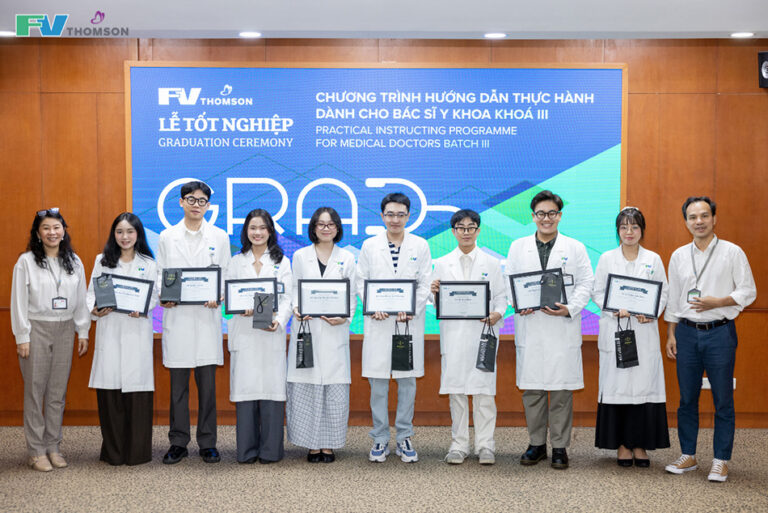
Congratulations to eight doctors on completing the Practical Instructing Programme – Batch III at FV
On 28 October 2026, FV Hospital held the Graduation Ceremony for the Practical Instructing Programme for the Issue of Medical Practice Licences to Medical Doctors – Batch III, marking the completion of 12 months of training and clinical practice for eight doctors. Eight doctors on completing the Practical Instructing Programme Opening the ceremony, Dr Vu […]

FV Run 2026: 3,300 runners unite, with VND 1 billion donated to support underprivileged children
On 31 October, FV Hospital, in partnership with the Children of Vietnam Charitable Fund and event operator Nexus Sport Events, officially launched FV RUN 2026 in Phu My Hung, Ho Chi Minh City. With more than 3,300 registered runners, the inaugural event brings the community together through sport and charitable giving. At the event, FV […]
Congratulations to eight doctors on completing the Practical Instructing Programme – Batch III at FV

