



All reasonable precautions have been taken by the World Health Organization to verify the information contained in this document. However, the published material is being distributed without warranty of any kind, either expressed or supplied. The responsibility or the interpretation of and use of this material lies with the reader. In no event shall the World Health Organization be liable for damages arising from its use.
WHO/HIS/SDS/2019.4 © World Health Organization 2019. Some rights reserved. This work is available under the CC BY-NC-SA 3.0 IGO licence. The 5 Moments for Medication Safety are the key moments where action by the patient or caregiver can greatly reduce the risk of harm associated with the use of their medication/s. Each moment includes 5 critical questions. Some are self-reflective for the patient and some require support from a health professional to be answered and reflected upon correctly. This tool for patient engagement has been developed as part of the third WHO Global Patient Safety Challenge: Medication Without Harm. It is intended to engage patients in their own care in a more active way, to encourage their curiosity about the medications they are taking, and to empower them to communicate openly with their health professionals. This tool is intended for use by patients, their families and caregivers, with the help of health professionals, at all levels of care and across all settings.
For patients, families and caregivers
Pay attention to these 5 MOMENTS when using medication/s. ASK these QUESTIONS and FIND the ANSWERS with the help of a health care professional whenever you:
- visit a doctor, nurse, pharmacist or dentist
- visit a primary health care facility or pharmacy
- are admitted to and discharged from a health care facility
- are referred to another health care facility
- are transferred to another health care facility
- receive treatment and care at home.
For health professionals
Promote patient engagement by introducing this tool to your patients, their families and caregivers and supporting them in answering the questions.
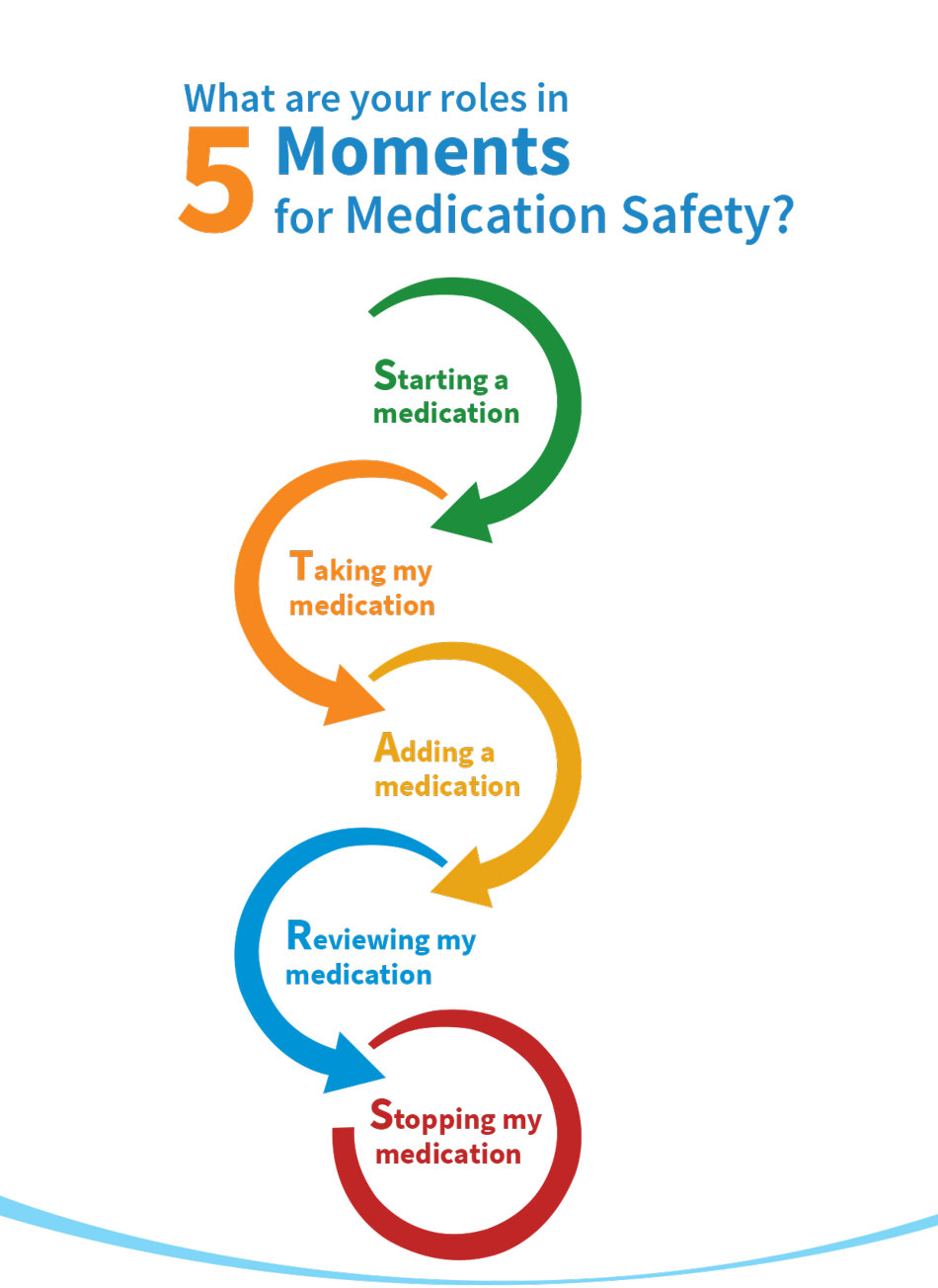
1. STARTING A MEDICATION
- What is the name of this medication and what is it for?
- What are the risks and possible side-effects?
- Is there another way of treating my condition?
- Have I told my health professional about my allergies and other health conditions?
- How should I store this medication?
2. TAKING MY MEDICATION
- When should I take this medication and how much should I take each time?
- How should I take the medication?
- Is there anything related to food and drink that I should know while taking this medication?
- What should I do if I miss a dose of this medication?
- What should I do if I have side-effects?
3. ADDING A MEDICATION
- Do I really need any other medication?
- Have I told my health professional about the medications I am already taking?
- Can this medication interact with my other medications?
- What should I do if I suspect an interaction?
- Will I be able to manage multiple medications correctly?
4. REVIEWING MY MEDICATION
- Do I keep a list of all my medications?
- How long should I take each medication?
- Am I taking any medications I no longer need?
- Does a health professional check my medications regularly?
- How often should my medications be reviewed?
5. STOPPING MY MEDICATION
- When should I stop each medication?
- Should any of my medications not be stopped suddenly?
- What should I do if I run out of medication?
- If I have to stop my medication due to an unwanted effect, where should I report this?
- What should I do with leftover or expired medications?
For more information, please visit: https://www.who.int/patientsafety/medication-safety/5moments/en/
Related Articles
Related Articles

FV Hospital Pregnancy Follow-up Package
Congratulations on your pregnancy and thank you for choosing FV Hospital as your healthcare service provider! A pregnancy is both a happy and challenging journey in the life of any women. To experience a healthy and safe pregnancy, as well as to give your baby the best beginning in life, mothers-to-be must undergo regular follow-ups […]
Orthokeratology (Night Lenses)
What is orthokeratology? Orthokeratology, or Ortho-K, is a non-surgical process that uses customised rigid contact lenses (specifically made for each patient) which are worn overnight to remodel the curvature of the cornea (the clear front surface of the eye). They are removed in the morning, allowing clear vision without correction during the day. The effects […]

Breast Cancer
Breast cancer is a very frequent cancer worldwide. In Vietnam its incidence has been increasing steadily and it is now the most common cancer affecting women. What are the Symptoms of Breast Cancer? Signs and symptoms of breast cancer may include: When to see a doctor? If you find a lump or other change in […]

Dentures Instructions
The new dentures you have received are a replacement for your missing teeth. They will attempt to restore support to the jaw, increase your chewing ability and improve your appearance. This information leaflet will assist you with your adjustment to new dentures. There are 2 types of dentures: Getting used to your new dentures For […]
FV Hospital Pregnancy Follow-up Package
Orthokeratology (Night Lenses)
Breast Cancer

