



Many people delay seeking professional help because they fear being labelled as having a “mental illness”. Doctors explain what these conditions really mean and how to prepare for your consultation.
Dr Phan Duy Thuc from the Department of Psychiatry at FV Hospital (HCMC) explained that when diagnosing patients with depression or anxiety disorders, he was often asked: “So, do I have a mental illness?”. This fear is precisely why some individuals delay seeking professional mental healthcare, leading to the risk of their condition worsening significantly.
“Negative attitudes towards mental health conditions still exist today, partly because people do not truly understand them. I always encourage patients to learn more about their condition. Once they understand its nature, they will feel less anxious and self-conscious, which plays a crucial role in eliminating the stigma attached to mental health issues,” said Dr Thuc.

Mental health conditions include many different forms. Some are not dangerous if detected and treated correctly. PHOTO: P.H illustration created using AI
Understanding mental health disorders properly
According to Dr Thuc, when hearing the term “mental illness”, many people only think of schizophrenia or psychotic disorders. In reality, mental health conditions encompass many different forms. Some disorders may last only for a short period, whilst others may last throughout a person’s life. Some can be life-threatening, but others are completely harmless if identified and treated properly.
Dr Nguyen Phi Yen, Specialist Level I, from the Psychosomatic Department at Thu Duc General Hospital (HCMC), explained that “mental illness” is an umbrella term referring to hundreds of mental health disorders, ranging from mild to severe. They can be broadly divided into two groups for easier understanding:
Common conditions, most of which respond well if detected and treated:
Anxiety disorders (common): Prolonged anxiety, irrational fear, rapid heart rate, shortness of breath, panic attacks, mainly affecting quality of life.
Depressive disorders: Persistent low mood lasting at least two weeks, loss of interest, fatigue, changes in sleep and appetite, low self-esteem, negative thoughts. These may become serious if accompanied by suicidal thoughts, but most respond well to treatment.
Obsessive-Compulsive Disorder (OCD), Post-Traumatic Stress Disorder (PTSD), Adjustment disorders: Often involving repetitive obsessive thoughts, compulsive behaviours, or strong reactions following traumatic events such as accidents or violence.
Conditions requiring early intervention:
- Bipolar disorder: Alternating episodes of depression and mania (abnormally high energy, reduced need for sleep, talkativeness, excessive spending, irritability…); carries a risk of impulsive or suicidal behaviour.
- Psychotic disorders (including schizophrenia): Hallucinations, delusions, disordered thinking and behaviour. Without treatment, patients may lose touch with reality, engage in self-harm or, in rare cases, harm other people.
- Some severe personality disorders: Emotional instability, fear of abandonment, and potential repetition of self-harming behaviours.
Additionally, there are other categories, including neurodevelopmental disorders (ADHD, autism), eating disorders, and more.
According to Dr Thuc, all mental health disorders share a common criterion: the symptoms must interfere with a person’s ability to function in daily life or impact the lives of those around them.
“If anxiety or depression prevents you from concentrating at work and your work performance declines, or if friends and colleagues start asking if you are alright, that alone is reason enough to seek a consultation,” added Dr Thuc.
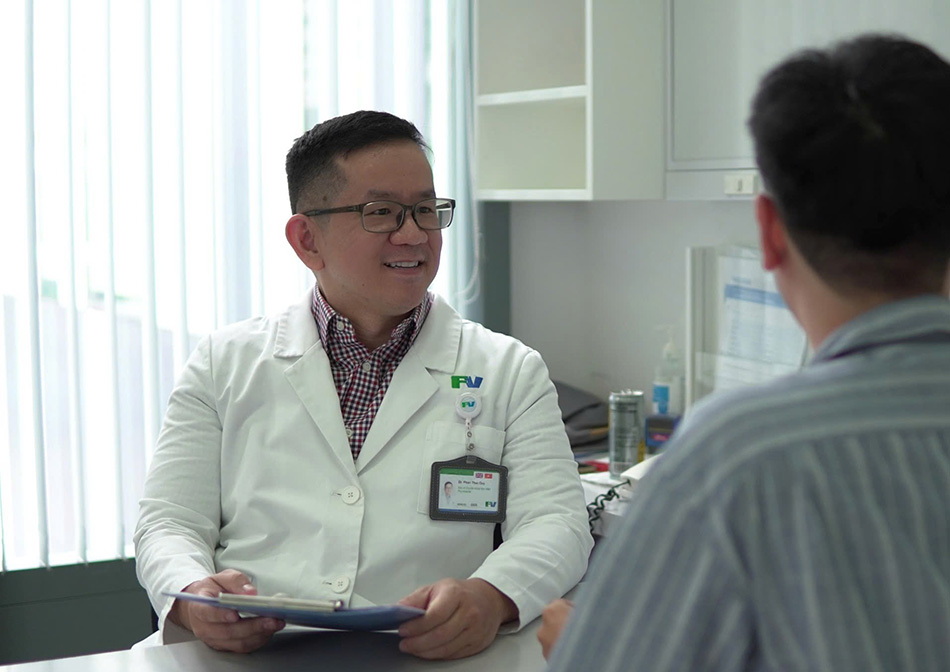
According to Dr Phan Duy Thuc, people should not wait until severe symptoms appear (such as having thoughts of self-harm or hearing voices that others cannot hear) before seeking support. Photo: Provided by FV Hospital
What should you prepare before your appointment?
Dr Nguyen Phi Yen advised that before visiting reputable medical facilities, patients should prepare the following to ensure an effective appointment:
- Medical history: Current symptoms (when they started, severity, factors that aggravate or relieve symptoms), past psychiatric and physical medical history, and family history.
- Current medicines: A complete list (including over-the-counter medicines and dietary supplements), dosages, and any previous side effects (if applicable).
- Symptom diary: Daily records of sleep, mood, diet, and triggers (for at least 1 to 2 weeks).
- Medical records: Including consultation notes, test results and psychological assessments, if any.
- Personal questions: Things you want to ask the doctor (about the diagnosis, treatment methods, side effects, and duration of treatment).
- Support person: You may bring a relative or friend if needed (to provide objective additional information).
| 15 million Vietnamese people are living with mental health disorders According to information shared at a scientific conference organised by the HCMC Medical Association on 18 July, an estimated 15% of the population in Vietnam (equivalent to around 15 million people) are living with at least one of the ten common mental health disorders. Among these, depression accounts for 2.8%, anxiety 2.6%, schizophrenia 0.4%, and substance abuse 4–5%. Assoc Prof Dr Nguyen Thi Ngoc Dung, President of the HCMC Medical Association, noted that the burden of mental health issues is rising against the backdrop of a changing society, work and life pressures, and rapid lifestyle changes. Anxiety disorders, depression, and prolonged stress are becoming more prevalent and affecting increasingly younger demographics. If not identified, diagnosed, and treated early, these disorders not only diminish patients’ quality of life but also place a heavy burden on the healthcare system and society. |
Source: Thanh Nien Newspaper
Related News
See moreRelated News
Two Vietnamese midwives attain international IBCLC certification in breastfeeding counselling
Two midwives from FV Thomson’s Maternity Department have earned IBCLC (International Board Certified Lactation Consultant) certification, the international credential for breastfeeding support specialists. This achievement represents a significant clinical milestone in infant feeding support at FV Hospital, driven by the real-world complexities these practitioners encounter daily when supporting mothers and their newborns. Beyond certification: A […]

FV Hospital Celebrates International Allied Health Professions Day 2026
On 14 October 2026, FV Hospital held a special event to express its appreciation for allied health professionals. Attendees included members of the Board of Directors, heads of departments, and more than 40 allied health professionals and specialists. The event recognised the dedication of allied health professionals across a range of specialties, including Dietetics and […]
FV pioneers ERAS® implementation in Vietnam in line with international standards, supporting faster postoperative recovery
FV Hospital has become the first hospital in Vietnam to partner with Sweden-based Encare AB to implement the Enhanced Recovery After Surgery (ERAS®) programme. Through this partnership, FV joins Encare’s network of 22 hospitals in 11 countries across the Asia-Pacific region. The initiative aims to standardise surgical care according to international guidelines, leverage data to […]
The Pink Month 2026 at FV: Raising awareness and taking proactive care of breast health
Every year, millions of women worldwide are diagnosed with breast cancer. In 2024, an estimated 2.43 million new cases and nearly 694,000 deaths from breast cancer were recorded globally. In Vietnam, GLOBOCAN 2022 estimated 24,563 new cases, making breast cancer the most commonly diagnosed cancer among women. Behind these statistics are the individual health stories […]
Two Vietnamese midwives attain international IBCLC certification in breastfeeding counselling
FV Hospital Celebrates International Allied Health Professions Day 2026
FV pioneers ERAS® implementation in Vietnam in line with international standards, supporting faster postoperative recovery

