




In a child’s everyday movements, the thumb accounts for up to 50% of the hand’s overall function. Without it, seemingly simple tasks like holding a pen to write, turning a page, or buttoning a shirt can become an overwhelming challenge.
At FV Hospital, the journey of little Le Minh Nhat, a four-and-a-half-year-old boy from Hanoi, to regain the function of his hand is a deeply moving story, shaped by the perseverance and love of his family.
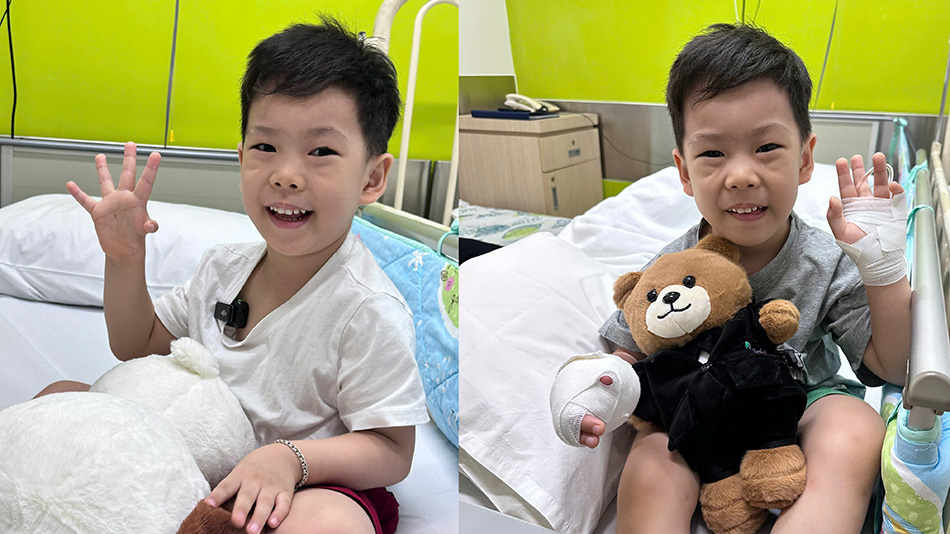
Minh Nhat before and after surgery
Four and a Half Years of Refusing to Give Up and a Chance Encounter with the Right Specialist
On the day their son was born, seeing that his limbs were complete and intact like any other child, the couple believed he was perfectly healthy. It was only on the third day after his birth that the nurse bathing the baby quietly spoke to Minh Nhat’s mother and said: “Ma’am, your baby’s thumb doesn’t seem to contain any bone. It appears to be hanging loosely…”
Those words marked the beginning of a more than four-year journey, taking the family through nearly ten major and minor hospitals from North to South. Minh Nhat was born with a congenital condition known as a “floating thumb”, a rare deformity where the thumb is merely a small soft-tissue appendage attached to the hand, completely lacking any internal bone, tendon, or nerve to control it. Most doctors shook their heads and offered only one solution: amputate the redundant finger.
However, if it were simply removed, his hand would remain permanently impaired, lacking the coordination between fingers needed to grip objects. To adapt, Minh Nhat had to practice pinching everything between his index and middle fingers. Watching her son prepare to start primary school but struggling immensely just to hold a pen, his mother refused to give up.
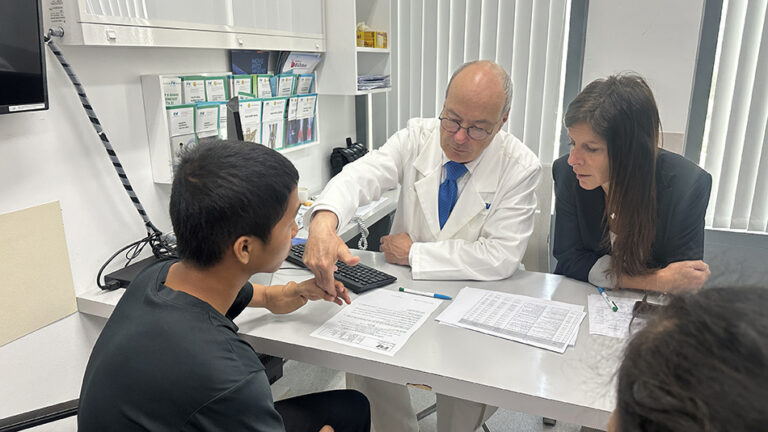
The turning point came when the family arrived at FV Hospital and was examined by Dr Stéphane Guero, a French hand surgery specialist with more than 30 years of experience. Unlike previous consultations, Dr Stéphane Guero looked beyond the deformity itself and focused on how the child used his hand in everyday life. Dr Stéphane Guero shared:
“Is the child gripping things by pinching them between two fingers? Carefully observing a child’s natural motor behaviour is a vital key for us to accurately assess how well the nervous system has adapted before planning the surgery.”
Pollicisation technique: A masterclass in structural “transposition” during a 2.5 hours operation
Instead of simply amputating the non-functional thumb remnant and accepting a hand missing a thumb, Dr Stéphane Guero and the FV team decided to perform pollicisation, a procedure that transforms the index finger into a functioning thumb. This is an exceptionally difficult technique in plastic and reconstructive surgery, transforming the index finger into a fully functional thumb in a single 2.5-hour operation. The procedure involved several stages: removing the non-functional floating thumb, shortening the index finger by removing approximately four-fifths of its metacarpal bone, and repositioning the finger to function as a thumb.
“The most critical factor in ensuring the survival and function of the new thumb is preserving its blood supply. The muscles, blood vessels, tendons and nerves of the index finger must be carefully dissected and preserved before being repositioned to their new location. Only then can the new thumb maintain a reliable blood supply and achieve good movement and function after healing,” Dr Stéphane Guero explained in technical detail.
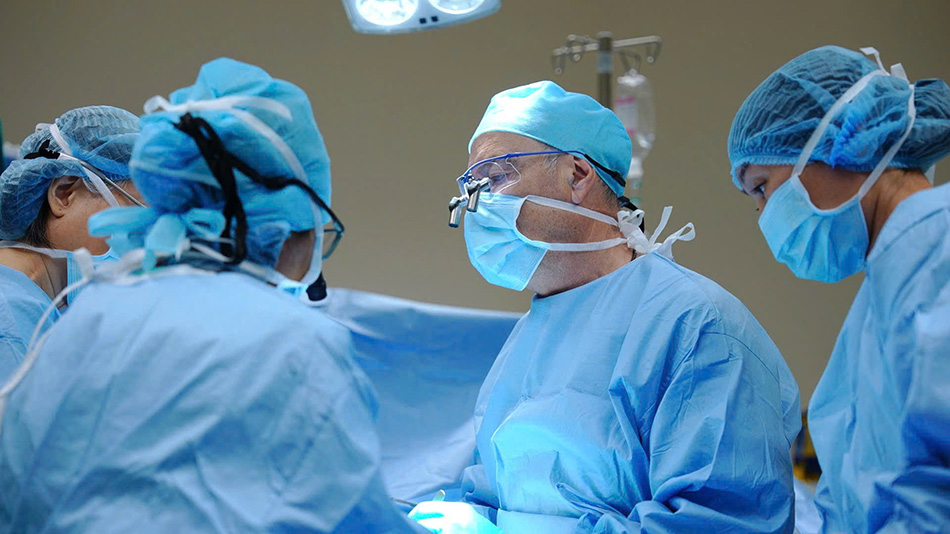
Stéphane Guero performing Minh Nhat’s reconstructive surgery
The brain’s miraculous adaptation and outstanding recovery outcomes
Many parents naturally wonder: With such a sudden change in finger positioning, how will the child learn to control it? Dr Stéphane Guero explained from a neurological perspective: “A child’s brain has a remarkable ability to adapt and reorganise itself. Before surgery, Minh Nhat had already learned to use his index finger to perform many of the functions normally carried out by the thumb. Thanks to this pre-existing reflex habit, once the reconstructed thumb has healed, his brain can adapt more quickly to controlling the reconstructed thumb, without the need for intensive rehabilitation.”
It is estimated that it will take around two months for the tissue swelling to completely subside and the bone structure to fully heal. Minh Nhat will then have improved hand function, with the pinch strength of the restored thumb reaching up to 7kg, which is approaching the pinch strength typically seen in adults (ranging from 5 to 10kg). He is also expected to be able to write, draw, perform grasping and picking movements for tiny objects, and even carry heavy items.
“Appearance is important, but when treating the hand, restoring function must always be the priority,” These discussions helped Minh Nhat’s family make an informed decision to proceed with surgery. Furthermore, Dr Stephane Guero shared, “The reconstructed four-fingered hand can look so natural that when he goes to school, even his teacher may not immediately notice the difference.”
At FV Hospital, Dr Stéphane Guero treats complex congenital hand deformities with the goal of maximising hand function while supporting the child’s long-term development. Dr Guero’s expertise, combined with the support of the FV multidisciplinary team, has not only given little Minh Nhat a strong pair of hands to start primary school with greater confidence, but has also opened up a future of independence without barriers. For the family, For the family, meeting the right specialist was the turning point that transformed what once seemed impossible into reality.
Related News
See moreRelated News

Nutcracker Syndrome: How a one-hour stent placement ended a year of abdominal pain
FV Hospital successfully treated a complex case of nutcracker syndrome using minimally invasive endovascular stenting, sparing the patient major open surgery. Persistent abdominal pain linked to renal vein entrapment For over a year, 41-year-old Ms V.T.K.P. from Ho Chi Minh City experienced persistent, dull lower abdominal pain that worsened with prolonged sitting or standing. As […]
Abdominal pain misdiagnosed as digestive issue: 23-year-old woman diagnosed with ovarian torsion
While studying abroad in South Korea, N.T.T.M. (23) experienced unusual pain in her lower right abdomen. She sought treatment at a local hospital and received medication for a suspected digestive issue. After returning to Vietnam to visit her family, the pain recurred and worsened. On her friends’ advice, M. visited FV Hospital for evaluation. She […]
Advanced robotic surgery at FV Hospital removes tumour near aorta
Surgeons at FV Hospital used the da Vinci Xi robotic surgical system to successfully remove a fibrous tumour located in a difficult-to-access area next to the aorta in a 46-year-old woman. Ms Nguyen Thuy Phuong Dung recovered well after surgery to remove the fibrous tumour from her left chest. Image: FV When a subtle chest […]
Boy with ‘boneless arm’ and decade-long journey to find hope
A jump at the age of six left young D.V.C. with devastating consequences: a left forearm almost entirely devoid of skeletal architecture, facing the prospect of limb amputation through joint disarticulation. For more than ten years, hope faded as every attempt at recovery stalled. It was only through the intervention of the Children of Vietnam […]
Nutcracker Syndrome: How a one-hour stent placement ended a year of abdominal pain
Abdominal pain misdiagnosed as digestive issue: 23-year-old woman diagnosed with ovarian torsion
Advanced robotic surgery at FV Hospital removes tumour near aorta

