




The procedure lasted approximately four hours, with the surgical team noting that the primary challenge was not merely the tumour’s anatomical position, but the intense time constraints inherent to the excision.
A significant renal tumour discovered at routine health check
Mr A. (an Australian patient in his forties) discovered a renal mass incidentally during a routine health check.
Following detailed clinical assessment, Dr Do Quang Minh, MSc, Specialist Level II, Head of the Urology & Andrology Department at FV Hospital, reported that the tumour measured over 5cm, with approximately half embedded deep within the renal parenchyma. Furthermore, the lesion was in direct contact with the renal collecting system, complicating surgical dissection.
Additionally, the patient presented with an anatomical variant: two renal arteries rather than the single artery typically supplying each kidney. This made intraoperative control of the renal blood supply significantly more challenging.
After careful consideration, the team opted for robotic-assisted surgery using the da Vinci Xi, one of the most advanced robotic surgical systems in Southeast Asia. It is particularly suited to complex urological procedures due to its capacity for precise manipulation within confined anatomical spaces.
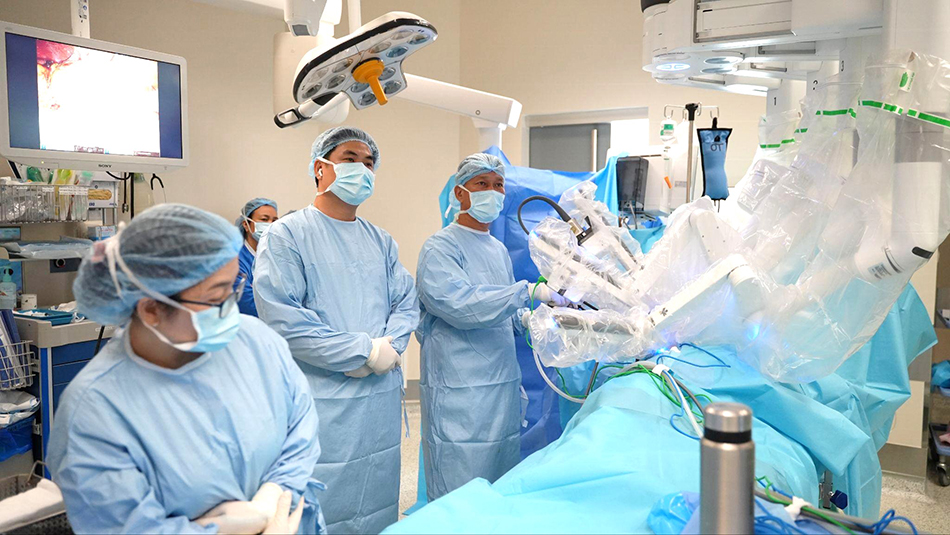
The Urology team performed robotic partial nephrectomy using the da Vinci Xi system. Image: FV
A race against time in the operating theatre
The procedure lasted approximately four hours. According to the surgical team, the greatest challenge lay not only in the tumour’s complex anatomical position, but in the considerable time pressure involved.
During excision, the surgeon must clamp the renal artery (or arteries) to temporarily halt blood supply to the kidney. Generally, warm ischaemia time should be kept under 30 minutes to avoid compromising long-term renal function. “It is truly a race against time; the longer the kidney is deprived of its blood supply, the greater the risk of tissue damage,” Dr Minh explained.
Thanks to seamless coordination within the surgical team and the support of the da Vinci Xi robotic system, the procedure achieved its most critical objective: complete excision of the tumour, with warm ischaemia time kept safely within the permitted threshold, thereby ensuring maximal preservation of healthy renal tissue.
“I made a remarkably swift recovery; I was back to eating normally and resuming my daily activities, and I didn’t even need any pain relief after the surgery,” the patient said.
The importance of regular screening in renal disease detection
According to Dr Do Quang Minh, MSc, Specialist Level II, renal tumours are often difficult to detect early as they frequently present with no clear symptoms in the initial stages. The majority of cases are identified incidentally through routine screening.
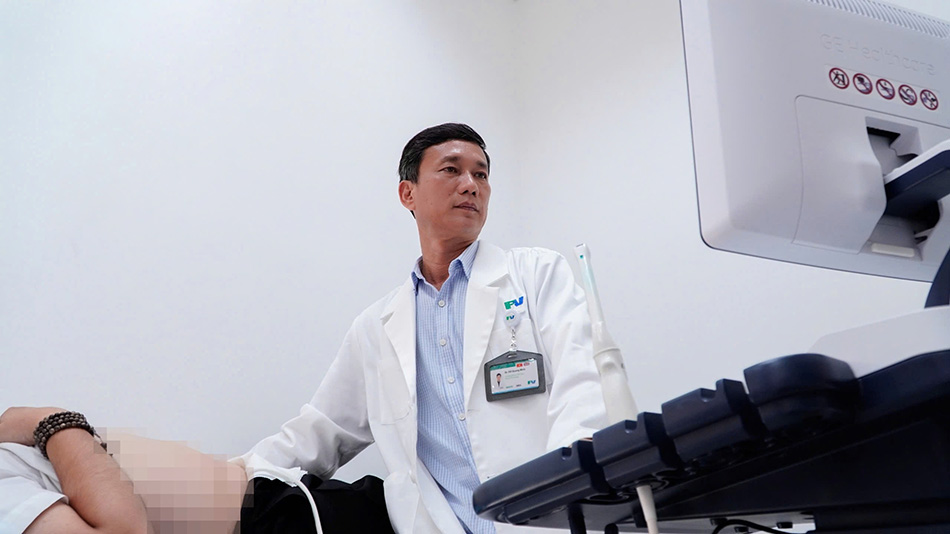
Dr Do Quang Minh, MSc, Specialist Level II, Head of the Urology & Andrology Department at FV Hospital, examining the patient. Image: FV
Abdominal ultrasound is a simple, fast and cost-effective screening method; yet, many people do not habitually undergo it until symptoms arise.
Doctors advise regular health screenings, particularly abdominal ultrasound, to enable early detection of underlying renal conditions and ensure the best possible treatment outcomes.
For enquiries or to book robotic surgery using the da Vinci Xi system, please visit FV Hospital, 6 Nguyen Luong Bang Street, Tan My Ward, Ho Chi Minh City, or call (028) 3511 3333.
Related News
See moreRelated News
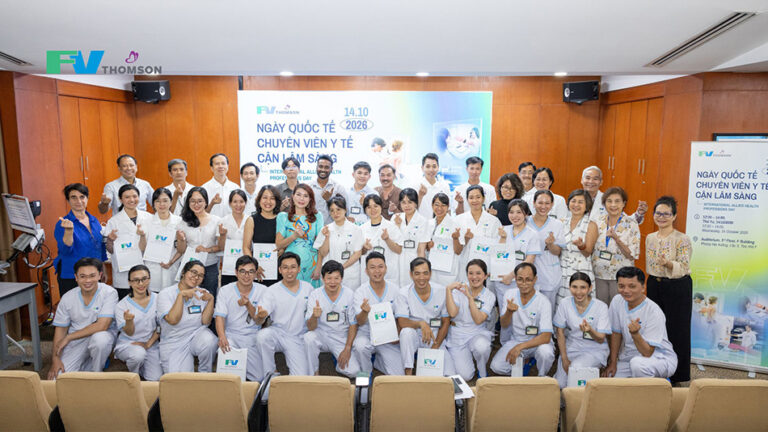
FV Hospital Celebrates International Allied Health Professions Day 2026
On 14 October 2026, FV Hospital held a special event to express its appreciation for allied health professionals. Attendees included members of the Board of Directors, heads of departments, and more than 40 allied health professionals and specialists. The event recognised the dedication of allied health professionals across a range of specialties, including Dietetics and […]
FV pioneers ERAS® implementation in Vietnam in line with international standards, supporting faster postoperative recovery
FV Hospital has become the first hospital in Vietnam to partner with Sweden-based Encare AB to implement the Enhanced Recovery After Surgery (ERAS®) programme. Through this partnership, FV joins Encare’s network of 22 hospitals in 11 countries across the Asia-Pacific region. The initiative aims to standardise surgical care according to international guidelines, leverage data to […]

Nutcracker Syndrome: How a one-hour stent placement ended a year of abdominal pain
FV Hospital successfully treated a complex case of nutcracker syndrome using minimally invasive endovascular stenting, sparing the patient major open surgery. Persistent abdominal pain linked to renal vein entrapment For over a year, 41-year-old Ms V.T.K.P. from Ho Chi Minh City experienced persistent, dull lower abdominal pain that worsened with prolonged sitting or standing. As […]

The Pink Month 2026 at FV: Raising awareness and taking proactive care of breast health
Every year, millions of women worldwide are diagnosed with breast cancer. In 2024, an estimated 2.43 million new cases and nearly 694,000 deaths from breast cancer were recorded globally. In Vietnam, GLOBOCAN 2022 estimated 24,563 new cases, making breast cancer the most commonly diagnosed cancer among women. Behind these statistics are the individual health stories […]
FV Hospital Celebrates International Allied Health Professions Day 2026
FV pioneers ERAS® implementation in Vietnam in line with international standards, supporting faster postoperative recovery
Nutcracker Syndrome: How a one-hour stent placement ended a year of abdominal pain

