



A Cambodian patient suffering a stroke due to a cerebral arteriovenous fistula was successfully treated at FV Hospital thanks to interventional radiology techniques. The outcome not only reflects advances in minimally invasive medicine but also highlights the expertise of FV’s specialised radiology team.
Acute stroke caused by an abnormal blood vessel
One seemingly ordinary morning, Mr N.V., 56, woke with a severe headache, his vision gradually became blurred, and he then collapsed to the floor. His family rushed him to the nearest hospital, where CT imaging revealed a haemorrhage in the posterior left region of his brain caused by a cerebral arteriovenous fistula. This vascular disorder occurs when an abnormal direct connection forms between arteries and veins in the brain, allowing high-pressure arterial blood to flow straight into veins and potentially leading to serious complications.

Severe headache and sudden vision loss are warning signs of a stroke.
Initial emergency care was provided by Cambodian doctors, who advised the family to transfer the patient to a facility capable of performing intracranial vascular interventions to definitively treat the condition and prevent recurrent haemorrhage. Seeking a non-surgical approach, the Cambodian physician referred Mr V.’s family to FV Hospital in Ho Chi Minh City, Vietnam.
Closing the fistula with interventional techniques: brain surgery without a scalpel
FV Hospital admitted the patient in an emergency condition, where he underwent a clinical examination and CT scan. Together with the medical records sent from Cambodia, these results enabled Dr Huynh Huu Danh, Specialist Level I, Imaging and Interventional Radiology Department, to decide on an endovascular approach to seal the cerebral arteriovenous fistula.
Endovascular intervention can effectively treat arteriovenous fistulas. Once the abnormal vessels are closed, blood can flow through healthy vessels without compromising the patient’s health. “We used a DSA system to create a detailed vascular map, then advanced a microcatheter from the femoral artery to the brain, directly to the fistula, and injected a specialised medical glue to seal the leaking vessel,” explained Dr Danh. “The procedure requires near-perfect precision; being even a few millimetres off can affect brain function.”
After three hours in the Cathlab, the arteriovenous fistulas were successfully sealed. The patient remained under general anaesthesia throughout to ensure safety and precise control at every step.
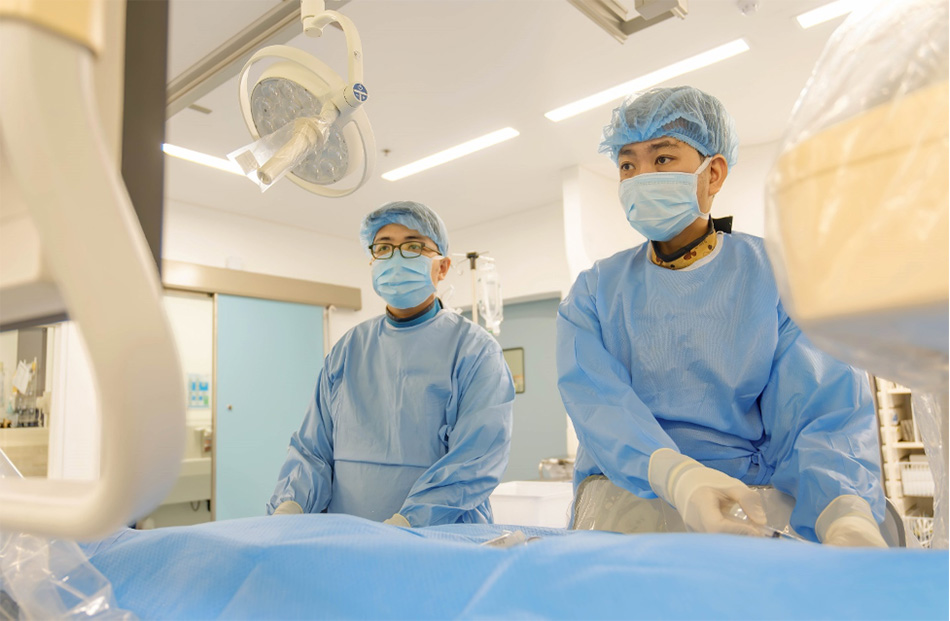
Dr Huynh Huu Danh (right) performing an endovascular procedure for a patient with a cerebral arteriovenous fistula
The patient recovered well after the procedure. After two days of monitoring, he was discharged in a stable condition. His family was overjoyed that Mr V. had been safely treated thanks to a minimally invasive procedure.
“Dr Danh explained my husband’s condition very clearly and thoroughly. The nursing team was quick, dedicated and professional. The service at FV is excellent. I made the right decision bringing my husband from Cambodia to FV for treatment,” Mrs N.V. shared gratefully.
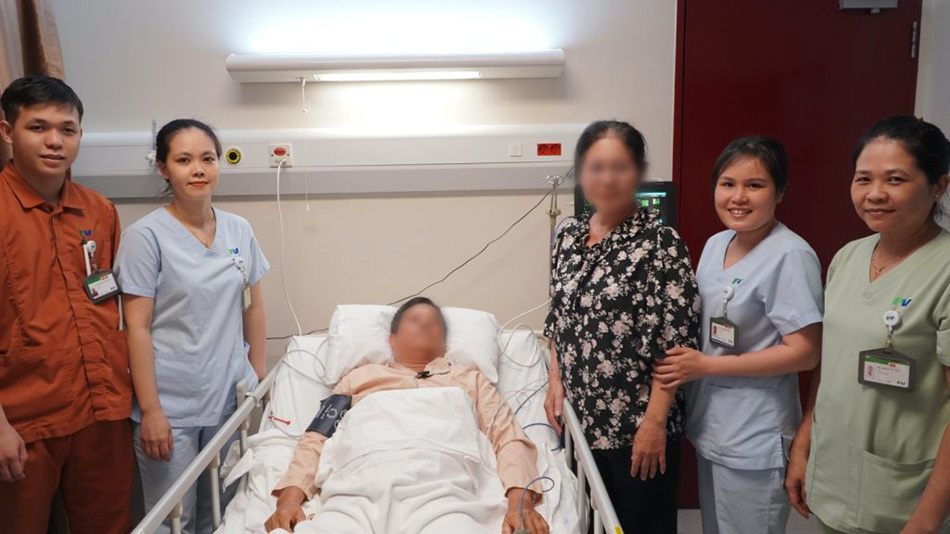
Mr N.V. and his wife with the FV Hospital nursing team.
During his most recent follow-up at the end of September 2025, Dr Danh reported that Mr N.V. had completely recovered from headaches, with full restoration of his vision. CT scans showed that all cerebral arteriovenous fistulas had been successfully sealed. The patient has since returned to normal daily life and work.
Minimally invasive and low risk: Advantages of endovascular intervention at FV
Endovascular intervention is considered a breakthrough in treating strokes, aneurysms and cerebral vascular malformations. Instead of opening the skull, doctors navigate through blood vessels to treat the problem from within, reducing pain, minimising complications and shortening hospital stays.
In Vietnam, FV Hospital is among the few private hospitals with an internationally certified Cathlab and advanced DSA systems capable of performing endovascular interventions. The medical team is highly trained and able to treat both adults and children.
Dr Huynh Huu Danh graduated with a Medical Doctor degree from Pham Ngoc Thach University of Medicine in 2016 and received a Specialist Level I in Diagnostic Imaging from the University of Medicine and Pharmacy, Ho Chi Minh City, in 2023. With over 10 years of experience in endovascular interventions, he is an expert in treating stroke, aneurysms, vascular malformations, arteriovenous fistulas, transarterial chemoembolisation (TACE) for liver cancer, embolisation for prostate and uterine tumours, intra-arterial chemotherapy (IAC) for retinoblastoma, and more. He is also one of the few doctors in Vietnam qualified to perform endovascular procedures for both adults and children.
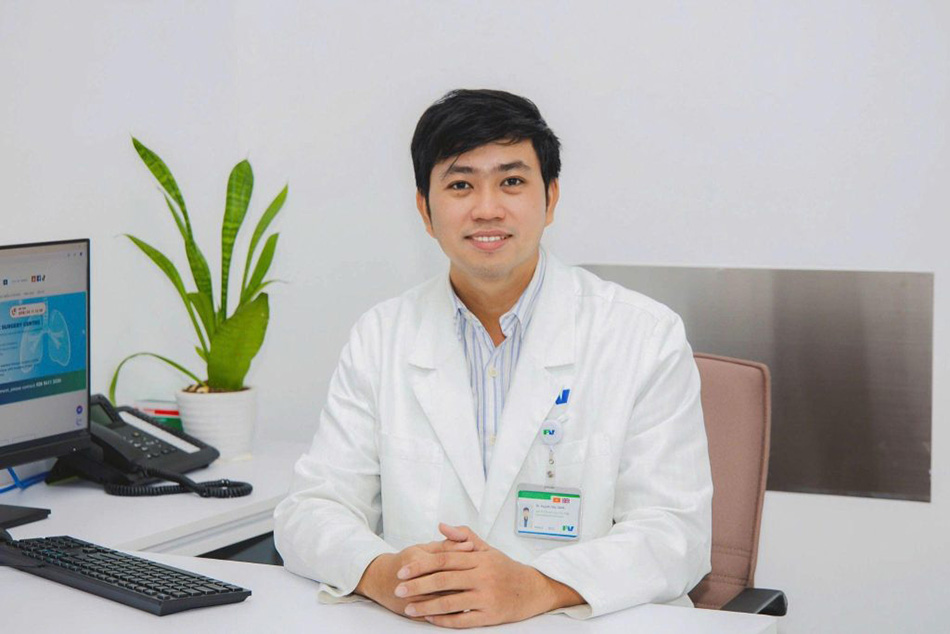
Dr Huynh Huu Danh, Specialist Level I, Imaging and Interventional Radiology Department, FV Hospital
For more information about endovascular procedures for stroke treatment, please contact FV Hospital at 06 Nguyen Luong Bang, Tan My Ward (formerly District 7), Ho Chi Minh City, or call (028) 3511 3333. Emergency hotline: (028) 3511 3500.
Related News
See moreRelated News
How FV Hospital saves Ukrainian man from 50 mm mandibular cyst
After a sudden toothache led to the discovery of a large mandibular cyst, a Ukrainian man spent six months searching for answers. His journey finally brought him to FV Hospital, where doctors crafted a two-stage treatment plan to preserve both his jawbone and teeth Dr Nguyen Thanh Tung, PhD, advising the patient on the treatment […]
Saving 60-year-old Vietnamese-American patient from complete bilateral pulmonary artery occlusion
A 60-year-old Vietnamese-American patient was admitted with severe respiratory failure due to blood clots blocking both pulmonary arteries, a condition that can quickly lead to acute heart failure or sudden death. Following prompt catheter-directed thrombectomy at FV Hospital, he fully recovered within one week. The patient received oxygen and was transported directly to the Emergency […]
Triumphant natural delivery: Mother overcomes unmedicated induced labour at FV Thomson Maternity
After a smooth first childbirth, Mrs Tran Hang expected a similar experience for her second delivery. However, intense induced labour contractions and complete resistance to anaesthesia required a change in approach. With her resilience and the dedicated support of the FV Thomson Maternity Department, she achieved a safe and joyful delivery. Mrs Tran Hang and […]
FV Hospital doctors publish two successful case reports on rare gynaecological conditions in an international medical journal
The reports, led by Dr Nguyen Duc Truong as the principal author, with co-authors Dr Vo Trieu Dat, MSc, and Dr Duong Bich Thuy, PhD, document two rare and complex gynaecological cases: a tubo-ovarian abscess caused by Salmonella and a twisted pedunculated fibroid. These publications provide additional clinical data on the diagnosis and management of […]
How FV Hospital saves Ukrainian man from 50 mm mandibular cyst
Saving 60-year-old Vietnamese-American patient from complete bilateral pulmonary artery occlusion
Triumphant natural delivery: Mother overcomes unmedicated induced labour at FV Thomson Maternity

