



In the past, many patients undergoing vascular interventions faced the risk of kidney toxicity and complications from contrast agents, which often prolonged hospital stays and increased treatment costs.
FV Hospital has successfully implemented CO₂-assisted angiography (Angiodroid CO₂), providing a safer treatment option for patients who cannot use iodine-based contrast agents, particularly those with kidney impairment.
CO₂ Technology – A Safe Angiography Solution for Patients with Kidney Disease or Allergies to Traditional Contrast Agents
Patient N.V.D., 76 years old, from An Giang, had a long history of diabetes and had been experiencing persistent pain, fatigue, and cramps in both legs when walking. Six months ago, he developed a wound on the fourth toe of his right foot. Despite visiting several medical facilities and using medications, the wound did not heal and gradually worsened. When the wound began to turn black and necrotic, his family brought him to FV Hospital.
Ultrasound and angiography at FV revealed complete blockage of the right iliac artery over a long segment, severe narrowing of the left iliac artery, complete obstruction of the right leg arteries, and over 90% blockage of the left leg arteries. Blood flow from the heart to both legs was almost completely blocked, causing toe necrosis and persistent pain in his right foot.
Specialist Level II, Luong Ngoc Trung, MD, MSc Head of Thoracic Vascular Endovascular Surgery at FV Hospital, stated that the patient has diabetes and kidney impairment, with a glomerular filtration rate (GFR) of 40 mL/min/1.73 m² (normal >90 mL/min/1.73 m²). He also had severe coronary artery stenosis, high blood pressure, and high cholesterol.
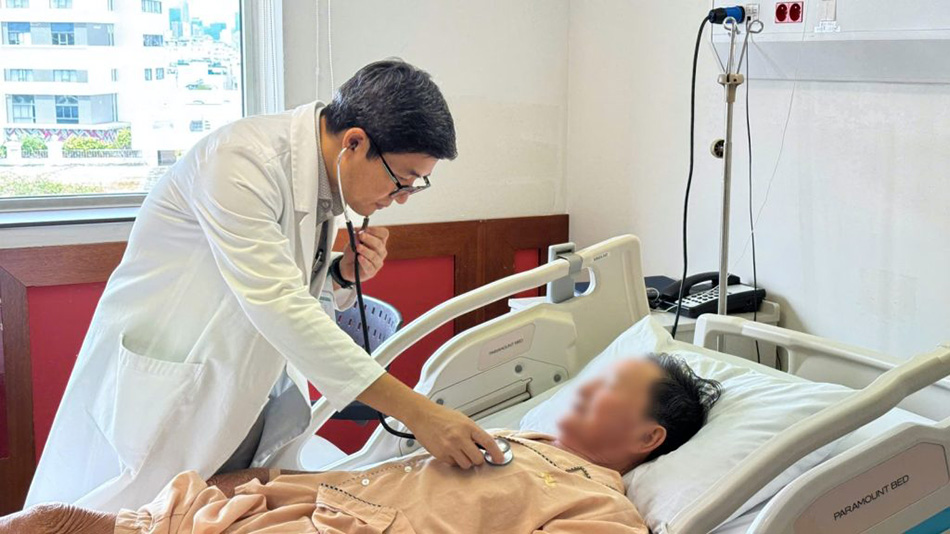
Dr Luong Ngoc Trung examines the patient.
Given the patient’s complex condition, including diabetes and severe kidney impairment, using iodine-based contrast agents for vascular intervention could have posed additional risks to the kidneys, particularly acute contrast-induced kidney injury. The FV Hospital team chose a new approach: performing angiography with CO₂ gas during the intervention using the Italian Angiodroid system.
With the Angiodroid system, pure CO₂ gas is injected into the blood vessels, replacing traditional contrast agents. This method still provides sharp X-ray images while helping protect kidney function. This technology is used in many advanced medical centres worldwide and is now being applied for the first time in Vietnam.
A Special Hybrid Surgery: Combining Endovascular Intervention and Bypass Surgery
Mr N.V.D.’s procedure was performed in the Cathlab with support from the Angiodroid CO₂ angiography system, the Philips Allura Xper DSA system, and other necessary instruments. The goal was to restore blood flow to the toe wound and promote healing.
First, Dr Trung treated the stenotic and blocked lesions in Mr N.V.D.’s abdomen using endovascular intervention, including balloon angioplasty and stent placement. This avoided traditional abdominal bypass surgery and restored blood flow to the arteries below the abdomen.
Next, because the patient’s right iliac artery was severely blocked and could not be treated endovascularly, Dr Trung performed bypass surgery, creating a short vascular bridge from the left femoral artery to the right femoral artery. The remaining blocked and narrowed arteries in both legs, including femoral and below-knee arteries, were also treated with balloon angioplasty and stent placement through small puncture sites.
After more than three hours for this hybrid procedure (combining endovascular intervention and bypass surgery), blood flow from the heart was successfully restored to both legs, improving overall perfusion.
“This was a particularly complex case. If we had performed only standard endovascular intervention, we could have treated only the left leg. The right iliac artery had a long-standing chronic blockage with heavy calcification, which endovascular techniques alone could not address,” Dr Trung explained.
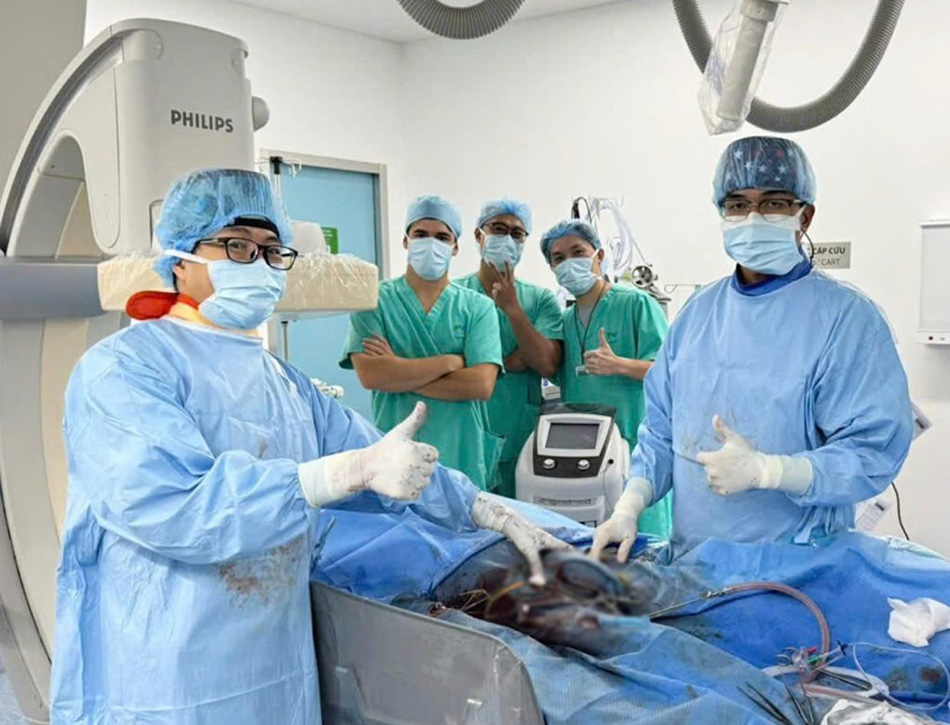
FV team successfully performs CO₂-assisted endovascular intervention and bypass for patient N.V.D.
After the surgery, the patient recovered quickly. Four days later, he was able to walk 500 meters, sleep well, and no longer felt sharp pain. The wound from the amputated necrotic toe began to heal. “I am truly grateful to the FV doctors and nurses for giving me a new lease on life,” he shared emotionally.
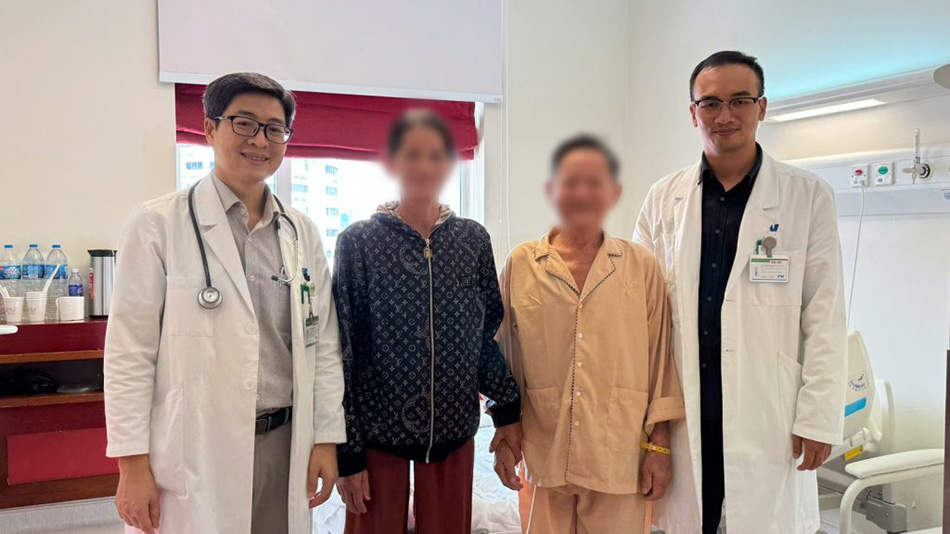
Dr Luong Ngoc Trung (left) visits Mr. N.V.D. the day before his discharge.
CO₂ Angiodroid: A Breakthrough in Vascular Intervention in Vietnam
The CO₂ Angiodroid angiography system functions as a medical “pump,” delivering CO₂ gas into the blood vessels to create images that clearly outline the vessel lumen.
The system precisely calculates the dose, pressure, and injection speed of CO₂, reducing the risk of vessel blockage from gas bubbles. At the same time, CO₂ acts as a biological contrast agent, providing X-ray image quality comparable to conventional iodine-based contrast agents.
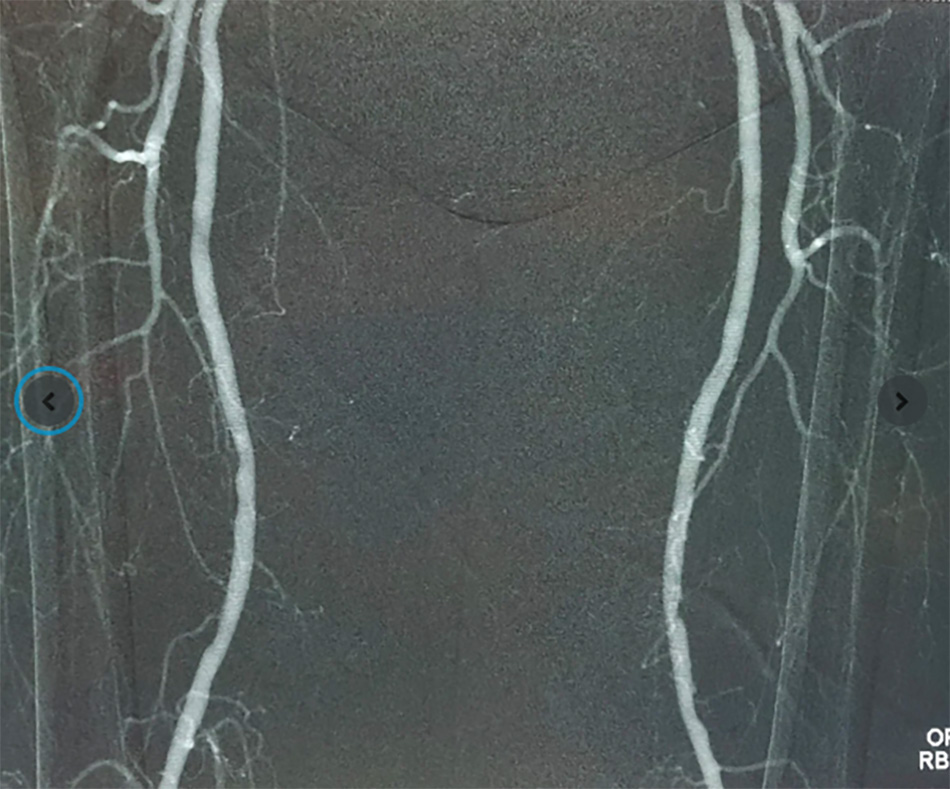
Pure medical CO₂ gas is injected to produce high-quality X-ray images.
This technology is particularly useful for:
- Patients allergic to iodine-based contrast agents
- Patients with kidney impairment or at risk of kidney toxicity from traditional contrast agents (e.g., those with diabetes or elderly patients)
- Interventions involving lower limb arteries, iliac arteries, the abdominal aorta, renal and hepatic arteries, and peripheral veins
- Diabetic foot cases requiring vascular assessment
For more information about this new method, visit FV Hospital at 06 Nguyen Luong Bang, Tan My Ward (former District 7), Ho Chi Minh City or call (028) 3511 3333.
Related News
See moreRelated News
FV Hospital unveils “A Standard of Medical Excellence” brand positioning, building on 23 years of “Trust in Medical Ethics”
After 23 years of consistently delivering international-quality healthcare to Vietnam, guided by its philosophy of “Trust in Medical Ethics”, FV Hospital, a member of Thomson Medical Group, officially introduces its new brand positioning, “A Standard of Medical Excellence”. This milestone reflects the achievements, expertise and core values that FV has built, demonstrated and earned recognition […]
Saving 60-year-old Vietnamese-American patient from complete bilateral pulmonary artery occlusion
A 60-year-old Vietnamese-American patient was admitted with severe respiratory failure due to blood clots blocking both pulmonary arteries, a condition that can quickly lead to acute heart failure or sudden death. Following prompt catheter-directed thrombectomy at FV Hospital, he fully recovered within one week. The patient received oxygen and was transported directly to the Emergency […]
Triumphant natural delivery: Mother overcomes unmedicated induced labour at FV Thomson Maternity
After a smooth first childbirth, Mrs Tran Hang expected a similar experience for her second delivery. However, intense induced labour contractions and complete resistance to anaesthesia required a change in approach. With her resilience and the dedicated support of the FV Thomson Maternity Department, she achieved a safe and joyful delivery. Mrs Tran Hang and […]
Patient Safety Week 2026 at FV Hospital: Safe care for non-communicable diseases
In response to World Patient Safety Day 2026, launched by the World Health Organization (WHO), FV Hospital is organising Patient Safety Week 2026 from 14 to 18 September 2026, under the theme “Safe care for non-communicable diseases”. Non-communicable diseases (NCDs), such as cardiovascular disease, diabetes, cancer, chronic respiratory diseases and many other long-term conditions, often […]
FV Hospital unveils “A Standard of Medical Excellence” brand positioning, building on 23 years of “Trust in Medical Ethics”
Saving 60-year-old Vietnamese-American patient from complete bilateral pulmonary artery occlusion
Triumphant natural delivery: Mother overcomes unmedicated induced labour at FV Thomson Maternity

