




A 66-year-old man with multiple health conditions faced a significant clinical dilemma: stopping his anticoagulant medication for surgery increased his risk of stroke. The FV Hospital surgical team used the da Vinci Xi robotic system to limit the interruption of anticoagulant therapy to 3 days, achieving complete tumour resection with only 10ml of blood loss. The patient recovered rapidly and was discharged four days after surgery.

Patient N.V.H. was discharged just 4 days after surgery. Image: FV
A pulmonary nodule discovered because of unrelated back pain
Mr N.V.H. (66, Ho Chi Minh City) had a long history of heavy smoking, averaging 2 packs per day. Ten years ago, after experiencing breathlessness, he was diagnosed with pleural effusion, which led him to quit smoking. He also has hypertension and type 2 diabetes, and requires daily anticoagulant medication to prevent thromboembolic events.
In late May 2026, Mr H. experienced persistent back pain for two days and sought assessment at FV Hospital’s Pain Management Department. A low-dose CT scan revealed a 20 mm pulmonary nodule in the right upper lobe. Due to active inflammation, malignancy could not be determined. Mr H. received anti-inflammatory medication and was scheduled for a follow-up in one month.
At his follow-up, with inflammation resolved, contrast-enhanced CT imaging showed the nodule had increased from 20 mm to 28 mm.
The case was presented to the multidisciplinary tumour board, which diagnosed a lung tumour with a high likelihood of malignancy and recommended immediate curative surgery without a pre-operative biopsy.
A clinical dilemma
The decision to operate marked the start of a complex clinical case. The main challenge was Mr H.’s ongoing anticoagulant therapy, which typically must be stopped for 5 to 7 days before surgery to reduce bleeding risk. However, stopping the medication immediately increases the risk of thromboembolism, including myocardial infarction or ischaemic stroke. The longer the interruption, the higher the risk.
In Mr H.’s case, delaying surgery was not an option due to the tumour’s rapid growth and high likelihood of malignancy.
After a thorough assessment of his clinical status, including coagulation profile, platelet count, white cell count, and physiological reserve, the surgical team proceeded with surgery after only 3 days off anticoagulant medication, much sooner than standard practice.
According to Dr Dang Dinh Minh Thanh, PhD, Specialist Level II, Head of the Thoracic Surgery Department at FV Hospital, this decision was based on the exceptional haemostatic control provided by the da Vinci Xi robotic system.
The system allows surgeons to operate with high precision in confined spaces, carefully dissecting vascular structures while minimizing injury to healthy tissue and reducing blood loss. The small port incisions, about 8 mm, also lead to less post-operative pain and faster recovery.
The treatment plan was approved by the multidisciplinary tumour board and received the family’s full and unequivocal support. “We had already looked into robotic surgery beforehand. Once Dr Thanh clearly explained the benefits and the steps being taken to minimise risk, our family felt completely reassured and had full confidence in his skill,” said Mr H.’s wife.
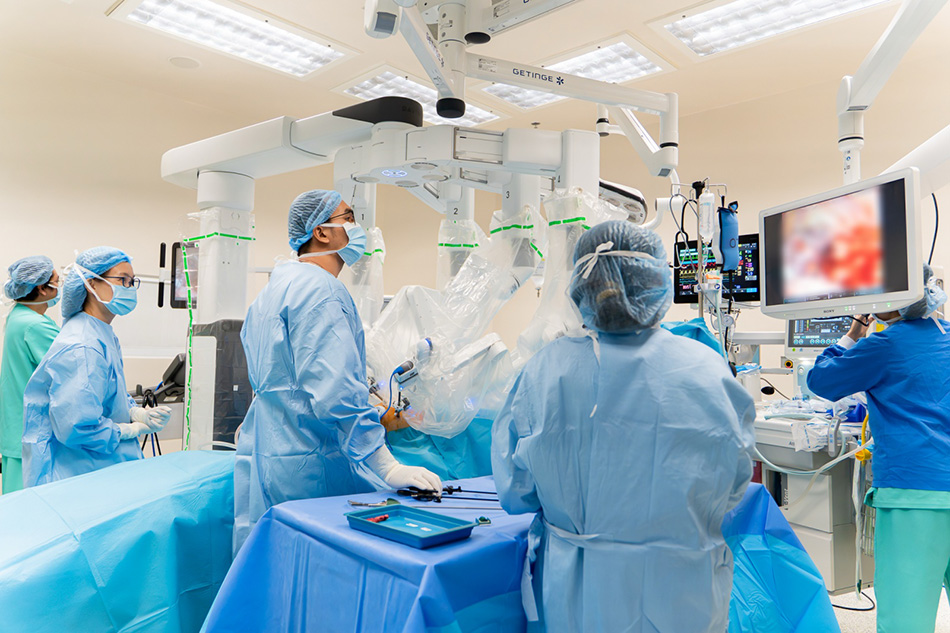
Ê-kíp bác sĩ FV thực hiện cắt u phổi bằng robot da Vinci Xi. Ảnh: Bệnh viện FV
Robotic lung cancer resection with only 10 ml blood loss, discharged after 4 days
The procedure was performed on June 25 under the direction of Dr Dang Dinh Minh Thanh. The surgical team observed pronounced peritumoral vascularity, a feature often seen in malignant tumours. Over 2 hours, the tumour and surrounding lymph nodes were fully resected, and the right upper lobe was removed as planned. Total blood loss was only 10 ml, demonstrating the robotic system’s exceptional haemostatic control.
Despite his underlying diabetes, Mr H.’s recovery progressed smoothly. Within 3 nights, his condition was nearly fully stable, and he was discharged on the fourth day.
“Dr Thanh and the nursing team were incredibly dedicated and attentive throughout my care. I want to offer my heartfelt thanks to every one of them,” Mr H. said, visibly moved.
Mr H. is awaiting histopathology and lymph node biopsy results to confirm the disease stage, which will guide his ongoing treatment plan.
Robotic surgery: An optimal approach to lung cancer treatment
Robotic laparoscopic surgery is currently the leading trend in thoracic surgery. Thanks to superior blood loss control, this technique helps reduce the need for blood transfusions by up to 75% and the mortality rate by 46% compared to traditional open surgery.
The robotic system also enables surgeons to access and clear deep-seated lymph nodes more easily, which is critical for accurate staging and lowering recurrence risk.
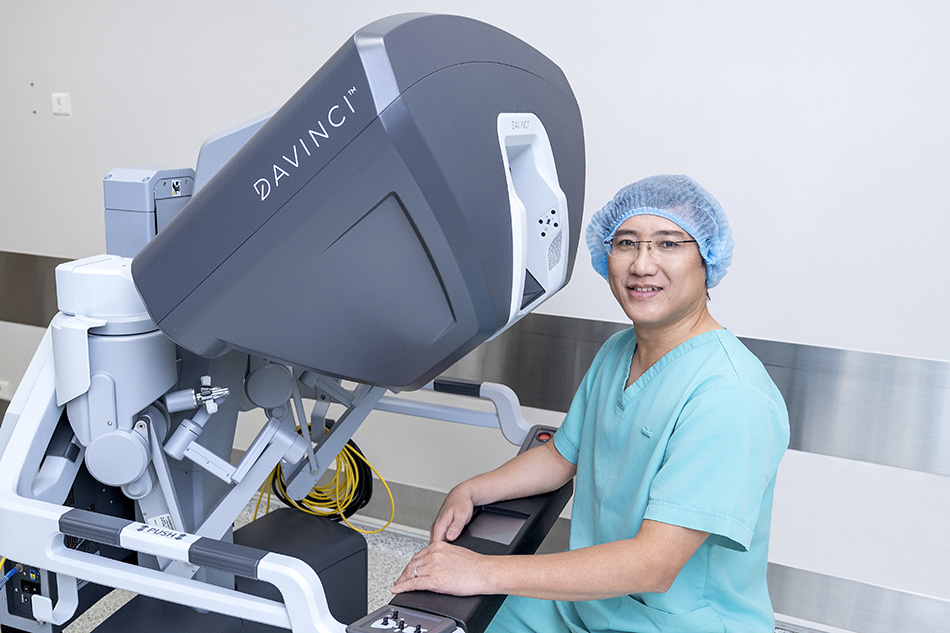
Dr Dang Dinh Minh Thanh, PhD, Specialist Level II, Head of the Thoracic Surgery Department. Image: FV
According to Dr Dang Dinh Minh Thanh, PhD, Specialist Level II, the use of the da Vinci Xi robotic system in lung cancer treatment at FV Hospital delivers outstanding results: “Precise tumour resection and lymph node dissection even in technically complex locations, minimal incisions, reduced blood loss, and faster patient recovery.”
To learn more about robotic surgery using the Da Vinci Xi system at FV Hospital, please contact FV Hospital directly at 6 Nguyen Luong Bang Street, Tan My Ward (formerly District 7), Ho Chi Minh City. Tel: (028) 3511 3333.
Related News
See moreRelated News
Two Vietnamese midwives attain international IBCLC certification in breastfeeding counselling
Two midwives from FV Thomson’s Maternity Department have earned IBCLC (International Board Certified Lactation Consultant) certification, the international credential for breastfeeding support specialists. This achievement represents a significant clinical milestone in infant feeding support at FV Hospital, driven by the real-world complexities these practitioners encounter daily when supporting mothers and their newborns. Beyond certification: A […]
FV Hospital Celebrates International Allied Health Professions Day 2026
On 14 October 2026, FV Hospital held a special event to express its appreciation for allied health professionals. Attendees included members of the Board of Directors, heads of departments, and more than 40 allied health professionals and specialists. The event recognised the dedication of allied health professionals across a range of specialties, including Dietetics and […]
FV pioneers ERAS® implementation in Vietnam in line with international standards, supporting faster postoperative recovery
FV Hospital has become the first hospital in Vietnam to partner with Sweden-based Encare AB to implement the Enhanced Recovery After Surgery (ERAS®) programme. Through this partnership, FV joins Encare’s network of 22 hospitals in 11 countries across the Asia-Pacific region. The initiative aims to standardise surgical care according to international guidelines, leverage data to […]

Nutcracker Syndrome: How a one-hour stent placement ended a year of abdominal pain
FV Hospital successfully treated a complex case of nutcracker syndrome using minimally invasive endovascular stenting, sparing the patient major open surgery. Persistent abdominal pain linked to renal vein entrapment For over a year, 41-year-old Ms V.T.K.P. from Ho Chi Minh City experienced persistent, dull lower abdominal pain that worsened with prolonged sitting or standing. As […]
Two Vietnamese midwives attain international IBCLC certification in breastfeeding counselling
FV Hospital Celebrates International Allied Health Professions Day 2026
FV pioneers ERAS® implementation in Vietnam in line with international standards, supporting faster postoperative recovery

