




FV Hospital successfully treated a complex case of nutcracker syndrome using minimally invasive endovascular stenting, sparing the patient major open surgery.
Persistent abdominal pain linked to renal vein entrapment
For over a year, 41-year-old Ms V.T.K.P. from Ho Chi Minh City experienced persistent, dull lower abdominal pain that worsened with prolonged sitting or standing. As her pain intensified, she sought medical evaluation. Based on CT findings, doctors suspected left renal vein Nutcracker syndrome, a condition in which the renal vein becomes compressed between two large arteries, obstructing blood flow and causing persistent pain, together with pelvic congestion caused by ovarian vein dilation.
Doctors initially recommended open surgery to address the ovarian vein dilation. However, Ms P. declined, hoping instead to find a non-surgical approach that could resolve both the Nutcracker syndrome and the ovarian vein dilation at the same time.
Ms P. came to FV Hospital seeking a definitive solution for her persistent symptoms. After reviewing her imaging studies, FV doctors confirmed Nutcracker syndrome. A normal renal vein typically measures 8–10 mm in width; hers had been compressed to just 1.5 mm.
According to Dr Luong Ngoc Trung, MSc, Specialist Level II, Head of the Vascular Surgery and Endovascular Surgery Department and a specialist in thoracic surgery and robotic surgery, the obstruction of blood return from the left kidney was causing venous congestion and flank pain, while the pooled blood continued to reflux into the left ovarian vein, dilating it and causing recurrent lower pelvic pain.
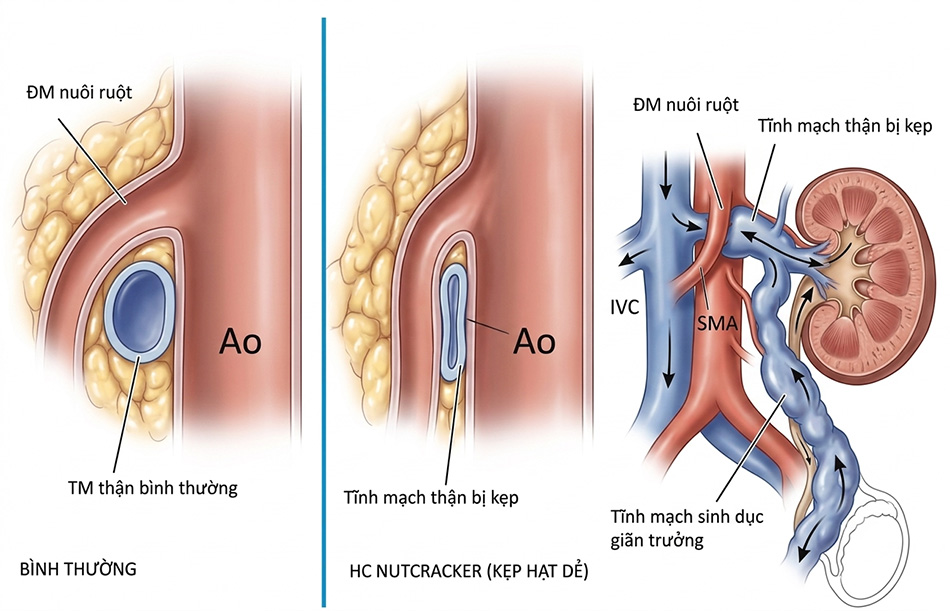
Normal renal vein anatomy compared to compressed renal vein pathology in Nutcracker syndrome. Image: FV
“Nutcracker syndrome is easily misdiagnosed as endometriosis or chronic colitis. Many patients endure months or even years of physical distress and clinical dead ends,” Dr Trung said.
Restoring renal vein blood flow within 1 hour
Having identified Nutcracker syndrome as the primary cause of Ms P.’s persistent pain, FV doctors recommended renal vein stenting to address both the venous narrowing and the pelvic congestion in a single procedure.
Under local anaesthesia, Dr Trung accessed the femoral vein, guided a wire across the 1.5 mm stenosis, and performed balloon angioplasty followed by placement of a vascular stent. This restored the vein’s normal diameter, re-established venous return, and prevented further collapse.
The surgical team then catheterised the left ovarian vein to assess the dilated, refluxing vessels for possible embolisation to treat pelvic congestion. They also evaluated the right ovarian vein and both internal iliac veins to rule out other sources of reflux. The results showed that the only affected site was on the left side, with the other dilated veins being a consequence of the obstruction rather than separate problems.
Post-stenting imaging showed complete resolution of retrograde reflux into the pelvic veins, confirming unobstructed flow through the stented renal vein.
Dr Trung noted that while conventional open reconstruction can take over 3 hours, this minimally invasive endovascular procedure was completed in one hour. It eliminated the need for a laparotomy and reduced the risks of post-operative adhesions and scarring.
Immediately after the procedure, Ms P.’s symptoms improved markedly. At follow-up, pelvic congestion had reduced by around 90%, her lower abdominal pain had resolved, and her left flank pain had also improved significantly. As the underlying inflammation had persisted for two to three years, full recovery was expected to take around a month.
Dr Trung noted that Nutcracker syndrome is a congenital condition, unrelated to lifestyle, and that not every case requires intervention. Patients with no symptoms, no haematuria, and no renal dilation can be safely managed with monitoring and conservative treatment alone.

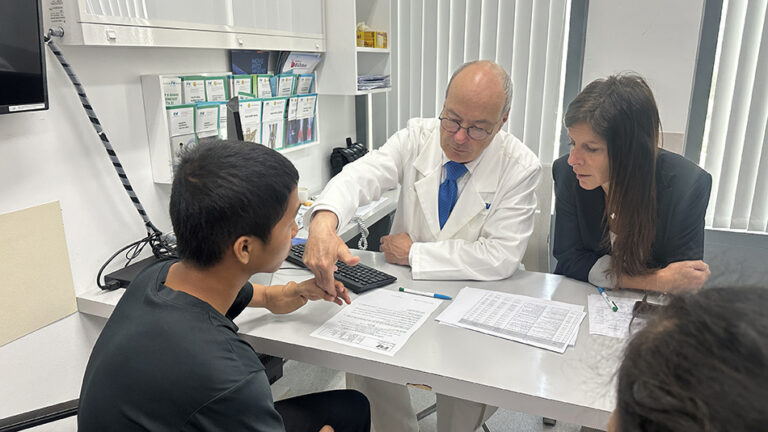
Dr Luong Ngoc Trung explaining the condition to a patient. Image: FV
“For patients with persistent lower abdominal or flank pain, identifying the true underlying cause is essential. It allows for definitive treatment, restores normal blood flow, and fully resolves any associated congestion,” Dr Trung emphasised.
Patients who undergo renal vein stenting are typically prescribed antiplatelet medication to protect the stent for around three months, along with periodic follow-up to monitor for restenosis. Because the underlying cause is treated directly, the risk of pelvic congestion recurring is very low.
To learn more about the treatment of nutcracker syndrome at FV Hospital, readers can visit 6 Nguyen Luong Bang Street, Tan My Ward (formerly District 7), Ho Chi Minh City, or contact (028) 3511 3333.
Related News
See moreRelated News

Abdominal pain misdiagnosed as digestive issue: 23-year-old woman diagnosed with ovarian torsion
While studying abroad in South Korea, N.T.T.M. (23) experienced unusual pain in her lower right abdomen. She sought treatment at a local hospital and received medication for a suspected digestive issue. After returning to Vietnam to visit her family, the pain recurred and worsened. On her friends’ advice, M. visited FV Hospital for evaluation. She […]
Advanced robotic surgery at FV Hospital removes tumour near aorta
Surgeons at FV Hospital used the da Vinci Xi robotic surgical system to successfully remove a fibrous tumour located in a difficult-to-access area next to the aorta in a 46-year-old woman. Ms Nguyen Thuy Phuong Dung recovered well after surgery to remove the fibrous tumour from her left chest. Image: FV When a subtle chest […]
Boy with ‘boneless arm’ and decade-long journey to find hope
A jump at the age of six left young D.V.C. with devastating consequences: a left forearm almost entirely devoid of skeletal architecture, facing the prospect of limb amputation through joint disarticulation. For more than ten years, hope faded as every attempt at recovery stalled. It was only through the intervention of the Children of Vietnam […]

TROP2-directed ADCs: A breakthrough in improving outcomes in advanced/metastatic triple-negative breast cancer
Advances in the treatment of advanced/metastatic triple-negative breast cancer are providing new treatment options for patients; particularly where existing therapies have limited efficacy. Among these, TROP2-directed antibody-drug conjugates (ADCs) are receiving increasing attention from the oncology community, supported by emerging clinical evidence on their efficacy and potential to improve treatment outcomes. The Scientific Seminar organised […]
Abdominal pain misdiagnosed as digestive issue: 23-year-old woman diagnosed with ovarian torsion
Advanced robotic surgery at FV Hospital removes tumour near aorta
Boy with ‘boneless arm’ and decade-long journey to find hope

