




For two years, despite seeking treatment both domestically and overseas, Ms K.S., 48 from Cambodia, saw no improvement in her coronary artery obstruction. Only after she came to Vietnam and visited FV Hospital did cardiologists discover the rare underlying cause, a hereditary lipid disorder, and from there implement a comprehensive treatment plan that addressed the immediate life-threatening condition and helped prevent future restenosis.
A brief episode of chest pain reveals a severe coronary blockage
One morning two years ago, Ms K.S. suddenly felt a sharp pain in her chest while cycling. The pain quickly subsided, but when she visited a local hospital in Cambodia, imaging results revealed a dangerous condition that had been silently progressing: a complete blockage in one branch of her coronary artery, preventing adequate blood flow to her heart and reducing its pumping capacity.
What followed was a long journey of seeking treatment at various hospitals in Cambodia and abroad. Although doctors examined her and prescribed medication, her progress remained minimal, and her chest discomfort and shortness of breath gradually worsened.
Following the advice of a Cambodian physician, she travelled to Vietnam and sought care at FV Hospital, home to a modern Cardiology Centre that regularly manages complex cases from across Vietnam and neighbouring countries, particularly Cambodia.

Young patients can still develop severe coronary artery disease due to hereditary lipid disorders.
After examining Ms S., Ho Minh Tuan, MD, PhD, Head of Cardiology and Interventional Cardiology at FV Hospital, confirmed that she had a chronic total occlusion of a coronary artery caused by atherosclerosis.
Coronary artery stenosis due to atherosclerosis is uncommon in patients younger than 50, so Dr Tuan suspected another underlying cause. After carefully reviewing her medical records and ordering additional tests, he identified the root of the blockage: a rare hereditary lipid disorder. Because this underlying cause had never been properly addressed, her condition failed to improve, and the risk of restenosis remained extremely high.
A two-in-one plan: reopening the coronary artery and controlling the root cause
Dr Tuan developed a comprehensive treatment plan for Ms S. with two key phases: interventional revascularisation of the coronary artery and long-term lipid control.
Her coronary intervention was performed in the Cathlab using a DSA system and OCT imaging, which provided detailed visualisation of the size and morphology of the obstructed artery. Dr Tuan advanced a catheter to the occlusion site, cleared the atherosclerotic plaque, performed balloon angioplasty, and deployed two stents to restore blood flow. The entire procedure took approximately one hour.
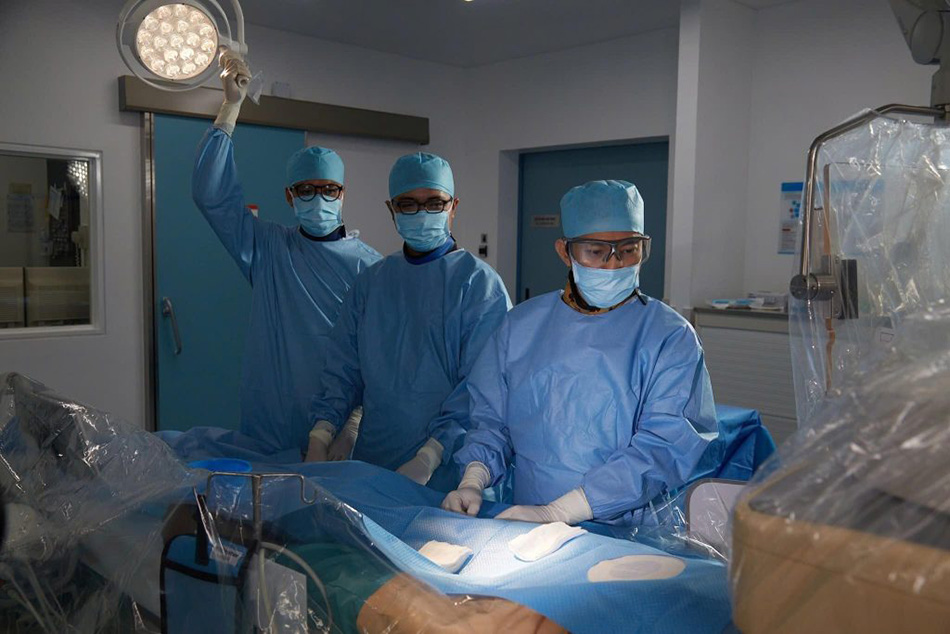
Ho Minh Tuan, MD, PhD (right) and his team place stents to restore the patient’s coronary artery.
Dr Ho Minh Tuan noted that Ms S. was fortunate to receive timely treatment. Had her condition remained untreated for longer, her heart’s pumping function would have progressively declined due to insufficient blood supply, and her symptoms of fatigue, chest pain, and heaviness could have worsened, potentially leading to fainting.
Following the procedure, Ms S. continued treatment to manage her lipid disorder. Dr Tuan prescribed a combination of oral and injectable medications to lower her blood lipid levels, alongside dietary adjustments, regular physical activity, stress management, and improved sleep. Her health gradually stabilised, her chest pain and shortness of breath resolved, and cardiovascular indicators such as heart rate and blood pressure remained stable at follow-up.
“When risk factors are well controlled, the likelihood of restenosis is very low, at under 1%,” Dr Tuan explained.
“I am grateful to Dr Tuan for accurately identifying the cause of my condition and treating it successfully. Thanks to him, I no longer experience fatigue or chest discomfort,” Ms K.S. shared on the day of her discharge.
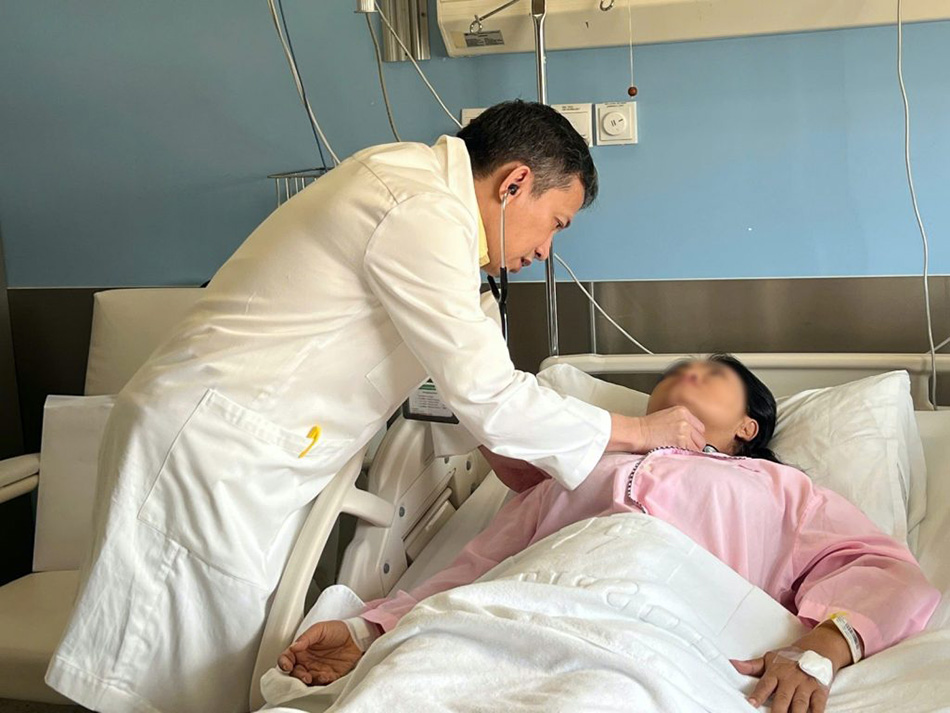
Dr Ho Minh Tuan examines Ms K.S. before her discharge
When Coronary Artery Disease Is No Longer Just an Old-Age Condition
Lipid disorders, whether hereditary or acquired, cause elevated blood fats to accumulate in vessel walls, leading to coronary artery disease and serious cardiovascular complications. Alarmingly, this condition is not uncommon among young people, yet it is often underestimated. According to Dr Tuan, young patients diagnosed with coronary artery stenosis at FV Hospital undergo advanced lipid profiling to ensure any issues are thoroughly addressed.
Thanks to its pioneering adoption of modern interventional cardiology techniques in line with global medical advancements, FV Hospital regularly receives and successfully treats complex cardiac emergencies referred from hospitals in Ho Chi Minh City, neighbouring provinces, and surrounding countries.
Notably, FV has a 24/7 “Golden Hour” myocardial infarction emergency team that follows the 70-minute “gold standard” protocol for cardiac emergencies and adheres to JCI quality standards, the world’s strictest patient safety benchmark. This enables many critically ill patients to be saved and to achieve remarkable recovery.
Moreover, to support early recovery after cardiovascular events, FV Hospital has established a dedicated Cardiac Rehabilitation team that brings together interventional cardiologists, physical therapy technicians, nurses, and specialised equipment.
For more information about coronary artery intervention at FV Hospital, please contact 06 Nguyen Luong Bang, Tan My Ward (formerly District 7), Ho Chi Minh City, or call (028) 35 11 33 33. Emergency hotline: (028) 35 11 35 00.
Related News
See moreRelated News

How 10 dental implants changed one patient’s life at FV Hospital
After years of tooth loss led to severe jawbone resorption and difficulty eating, specialists at FV Hospital restored the patient’s smile by placing 10 dental implants in one procedure. How years of tooth loss lead to jawbone loss For many years, Mr Lam Quang Kieu Phong (55, Ho Chi Minh City) experienced tooth loss. Some […]

Nutcracker Syndrome: How a one-hour stent placement ended a year of abdominal pain
FV Hospital successfully treated a complex case of nutcracker syndrome using minimally invasive endovascular stenting, sparing the patient major open surgery. Persistent abdominal pain linked to renal vein entrapment For over a year, 41-year-old Ms V.T.K.P. from Ho Chi Minh City experienced persistent, dull lower abdominal pain that worsened with prolonged sitting or standing. As […]

Abdominal pain misdiagnosed as digestive issue: 23-year-old woman diagnosed with ovarian torsion
While studying abroad in South Korea, N.T.T.M. (23) experienced unusual pain in her lower right abdomen. She sought treatment at a local hospital and received medication for a suspected digestive issue. After returning to Vietnam to visit her family, the pain recurred and worsened. On her friends’ advice, M. visited FV Hospital for evaluation. She […]
Advanced robotic surgery at FV Hospital removes tumour near aorta
Surgeons at FV Hospital used the da Vinci Xi robotic surgical system to successfully remove a fibrous tumour located in a difficult-to-access area next to the aorta in a 46-year-old woman. Ms Nguyen Thuy Phuong Dung recovered well after surgery to remove the fibrous tumour from her left chest. Image: FV When a subtle chest […]
How 10 dental implants changed one patient’s life at FV Hospital
Nutcracker Syndrome: How a one-hour stent placement ended a year of abdominal pain
Abdominal pain misdiagnosed as digestive issue: 23-year-old woman diagnosed with ovarian torsion

