




A Canadian woman who had nearly lost the ability to walk due to spinal canal stenosis was successfully treated at FV Hospital and was able to return home just one week after surgery.
More than thirty years ago, Ms M.C. (49, Canada) underwent scoliosis correction surgery. In the past year, she developed severe back pain radiating down her right leg, limiting her to walking only 100 to 200 metres before needing to stop.
After seeing doctors at several major hospitals in Canada and the United States, she was diagnosed with L4-L5 spondylolisthesis, causing spinal canal stenosis and compression of the adjacent nerve root. Her case was especially complex because she still had the original spinal hardware from her surgery decades ago. Using conventional treatment methods, surgeons would have had to remove the entire existing hardware system and replace it in full.
Given the significant risks and uncertain outcome of major surgery, Ms M.C. hesitated to proceed. She continued seeking alternatives and ultimately chose to travel to Vietnam for treatment at FV Hospital.
Dr Tran Luong Anh, Specialist Level II, Head of the Neurosurgery and Spine Surgery Department, examined the patient and noted: “After more than 30 years, the bone had fused solidly, incorporating almost the entire hardware system within mature bone. Removing it would require deliberately cutting through this consolidated bone, making the procedure considerably more complex and higher-risk.”
The complexity was compounded further by a pedicle screw at the right L4 vertebra that had fractured years earlier, and the fragment was still deep inside the bone. This blocked the usual path for placing a new screw at that spot.
Before surgery, the FV surgical team collaborated with the Pain Management Unit to perform a diagnostic nerve block, confirming the exact source of her pain. The results showed her pain was caused by spondylolisthesis and nerve compression. Since pain relief from this procedure lasted less than a month, surgery was the only viable option to preserve her mobility.
A breakthrough treatment strategy from FV’s specialist team
Recognising the rarity and complexity of this case, the FV medical team agreed on an innovative strategy: extend the existing fusion with new instrumentation only at the affected level, leaving the original fused hardware undisturbed. This approach minimised trauma to the patient. To implement this plan, the hospital sourced specialised connector hardware from overseas, as domestic suppliers could not provide the necessary components.
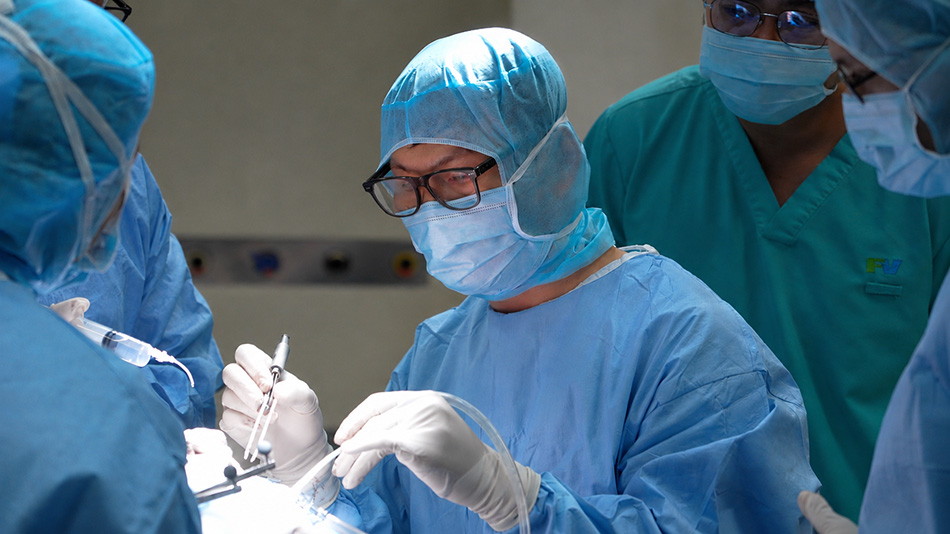
The procedure was performed with the support of the intraoperative spinal navigation system.
To insert the new screws while avoiding the fractured screw fragment, the surgical team used an intraoperative spinal navigation system. This system used CT imaging data to create a real-time three-dimensional model of the spine, enabling precise tracking of each instrument to within a millimetre during the procedure.
“The navigation system allowed us to select a safe trajectory for each new screw, avoiding the fractured fragment still lodged within the vertebral body. Even a deviation of just a few millimetres could have meant a repeat surgery, or lasting harm to the patient’s mobility,” Dr Tran Luong Anh explained.
A standard procedure for spondylolisthesis typically takes around two hours. However, owing to the exceptional complexity of this case, the operation took considerably longer than anticipated. After more than three hours in the operating theatre, the surgical team successfully placed four new pedicle screws, inserted an interbody fusion device at the L4-L5 level, and achieved complete decompression of the affected nerve root.
Why you should never ignore lingering back pain
After surgery, Ms M.C. stayed in the hospital for about one week and began a structured physiotherapy programme. Her pain improved and her mobility recovered. One month after the operation, she was cleared to travel and returned home to Canada.
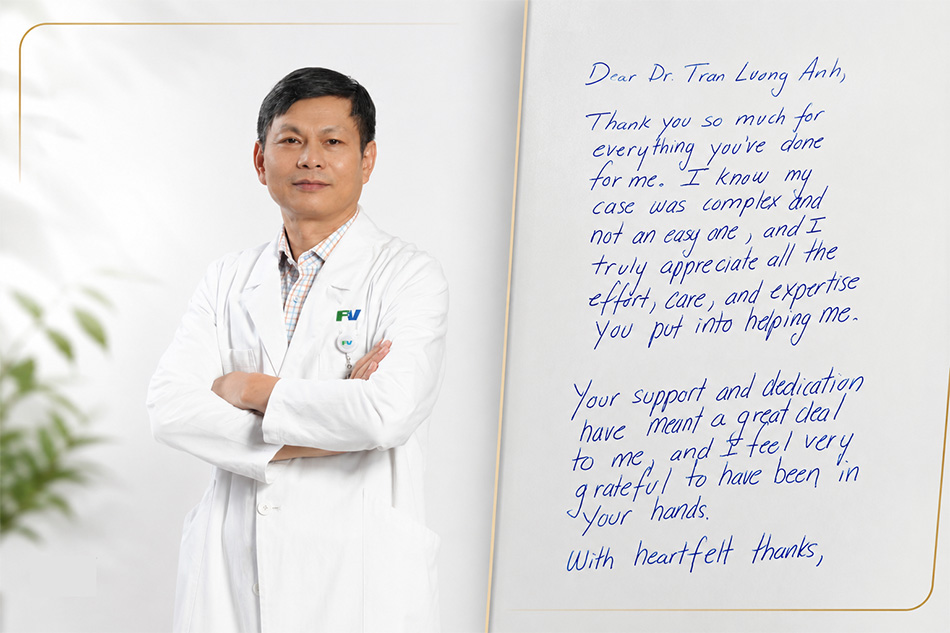
A handwritten letter of gratitude from the patient to Dr Trần Lương Anh, written before her return home.
According to Dr Tran Luong Anh, people should never dismiss persistent back pain, pain radiating down the leg, or difficulty walking or standing for extended periods. These can be warning signs of serious underlying conditions, such as spondylolisthesis, spinal canal stenosis, or nerve compression.
This is particularly important for patients with a history of prior spinal surgery, as anatomical changes accumulating over time can make future treatment considerably more complex. Early detection and timely intervention at a reputable medical facility are essential to preserving mobility and long-term quality of life.
For more information about spinal condition treatment at FV Hospital, please visit us at 6 Nguyen Luong Bang Street, Tan My Ward (formerly District 7), Ho Chi Minh City, or call (028) 3511 3333.
Related News
See moreRelated News
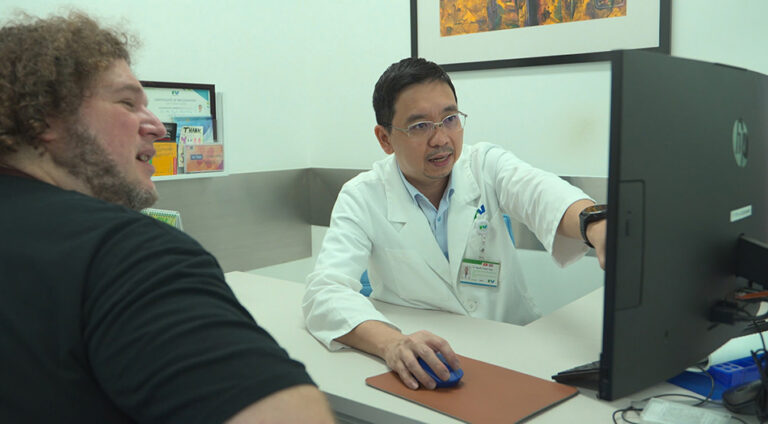
How FV Hospital saves Ukrainian man from 50 mm mandibular cyst
After a sudden toothache led to the discovery of a large mandibular cyst, a Ukrainian man spent six months searching for answers. His journey finally brought him to FV Hospital, where doctors crafted a two-stage treatment plan to preserve both his jawbone and teeth Dr Nguyen Thanh Tung, PhD, advising the patient on the treatment […]
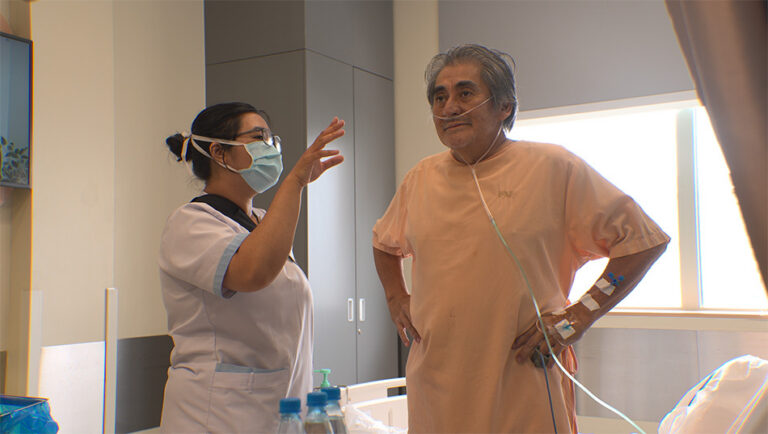
Saving 60-year-old Vietnamese-American patient from complete bilateral pulmonary artery occlusion
A 60-year-old Vietnamese-American patient was admitted with severe respiratory failure due to blood clots blocking both pulmonary arteries, a condition that can quickly lead to acute heart failure or sudden death. Following prompt catheter-directed thrombectomy at FV Hospital, he fully recovered within one week. The patient received oxygen and was transported directly to the Emergency […]
Triumphant natural delivery: Mother overcomes unmedicated induced labour at FV Thomson Maternity
After a smooth first childbirth, Mrs Tran Hang expected a similar experience for her second delivery. However, intense induced labour contractions and complete resistance to anaesthesia required a change in approach. With her resilience and the dedicated support of the FV Thomson Maternity Department, she achieved a safe and joyful delivery. Mrs Tran Hang and […]
FV Hospital doctors publish two successful case reports on rare gynaecological conditions in an international medical journal
The reports, led by Dr Nguyen Duc Truong as the principal author, with co-authors Dr Vo Trieu Dat, MSc, and Dr Duong Bich Thuy, PhD, document two rare and complex gynaecological cases: a tubo-ovarian abscess caused by Salmonella and a twisted pedunculated fibroid. These publications provide additional clinical data on the diagnosis and management of […]
How FV Hospital saves Ukrainian man from 50 mm mandibular cyst
Saving 60-year-old Vietnamese-American patient from complete bilateral pulmonary artery occlusion
Triumphant natural delivery: Mother overcomes unmedicated induced labour at FV Thomson Maternity

