




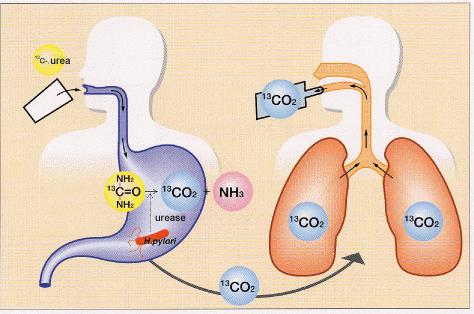
H. pylori is a spiral bacterium implicated in gastritis, gastric ulcer, and peptic ulcer disease. The 13C-urea breath test breath test is a rapid noninvasive diagnostic procedure used to identify infections by Helicobacter pylori (H. pylori) and to confirm eradication after treatment. It is based upon the ability of H. pylori to convert urea to ammonia and carbon dioxide. This “point-of-care” testing is now possible at FV Hospital.
HOW DO I PREPARE FOR A UREA BREATH TEST?
13C is a nonradioactive and harmless isotope, and it can be safely used in children and women of childbearing age but is not recommended for:
- Pregnant women and breastfeeding women
- Children under three years old.
You will be required to fast for two hours before the test. This means:
- No food or fluids;
- Do not consume soft drinks or even water;
- Do not smoke.
You should take only the medications approved by your doctor on the day of the procedure. Prior to the test, your doctor will ask you to stop taking antibiotics and the following anti-acid medications which decrease the amount of urease in the stomach:
- Antibiotics – at least four weeks before the test;
- Bismuth preparations – at least two weeks before the test (bismuth tripotassium dicitrate – Inbionetdesnol® or Ducas®);
- Proton pump inhibitors – at least two weeks before the test, such as esomeprazol (Nexium®), omeprazole (Mepraz®, Losec®), pantoprazole (Pantoloc®), rabeprazol (Pariet®);
- Histamine H2-receptor antagonists – at least one day before the test, such as ranitidine (Zantac®, Ratidin®);
- Antacids – at least one day before the test, such as aluminium phosphate (Phosphalugel®), aluminium hydroxide + magnesium hydroxide (Maalox®), rebamipide (Mucosta®), sodium alginate + sodium bicarbonate + calcium carbonate (Gaviscon®), sodium hydrocarbonate (Natri Bicarbonat®).
WHAT HAPPENS DURING THE UREA BREATH TEST?

During the urea breath test:
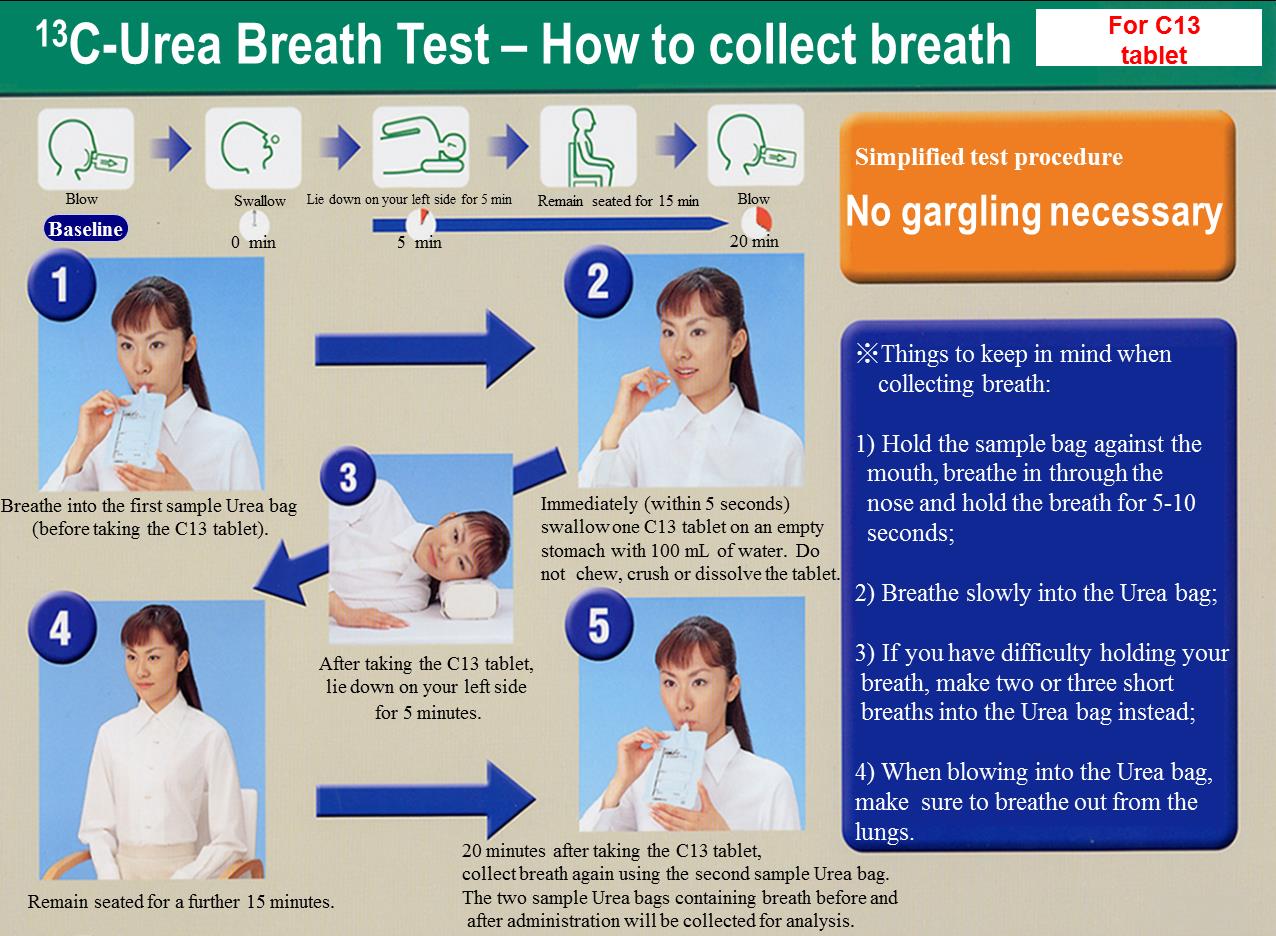
- A nurse will explain the procedure and answer any questions you may have; • You will breath into the first sample bag;
- Then, you will swallow a tablet of urea labelled with nonradioactive isotope carbon 13 (13C-labelled urea) and lie down on your left side for five minutes;
- After, you will have to remain seated for a further 15 minutes;
- 20 minutes after taking the tablet, the nurse will collect breath again using the second sample bag.
HOW DOES THE TEST WORK?
If present in the gastric environment, H. pylori will breakdown the carbon-labelled urea into carbon dioxide (CO2) and ammonia. Isotope-labelled 13CO2 is exhaled through the lungs and can be measured in the exhaled air.
WHAT HAPPENS AFTER THE UREA BREATH TEST?
After the urea breath test:
- Your two sample bags containing breath before and after administration will be collected for analysis;
- You may resume your normal activities;
- You may resume your normal diet, unless you are scheduled for other tests that require dietary restrictions.
WHAT ABOUT THE RESULTS AND THE TREATMENT?
Results are obtained immediately and will be communicated to you by your gastro-enterologist who will decide the appropriate treatment if it is required.
Related Articles
Related Articles

Virtual Colonoscopy (CT Colonography)
WHAT IS A VIRTUAL COLONOSCOPY? Virtual colonoscopy, also called CT colonography, is a method of screening the colon for precancerous polyps using a CT scanner. CT scanning is a non-invasive medical test that combines special x-ray equipment with sophisticated computers to produce multiple images of the inside of the body. CT colonography provides an interior […]
Colonoscopy
COLONOSCOPY OVERVIEW Colonoscopy is an investigation that allows your doctor to look at the inner lining of your large intestine (rectum and colon) using a thin, flexible tube called a colonoscope. A colonoscopy helps find ulcers, polyps, tumors, and areas of inflammation or bleeding. During a colonoscopy, tissue samples can be collected (biopsy) and abnormal […]
FIBROSCAN
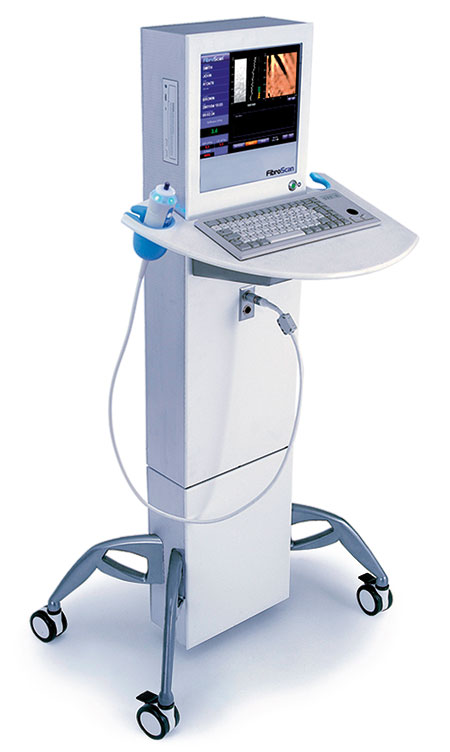
FibroScan FibroScan is the first and only non-invasive device for diagnosis and monitoring of hepatic fibrosis. Why do we need to quantify liver fibrosis? In its initial stages, liver fibrosis develops silently and often causes no symptoms. Early diagnosis and treatment will help prevent the disease from progressing to liver cancer, liver function failure, or […]
Endoscopic retrograde cholangiopancreatography (ERCP)
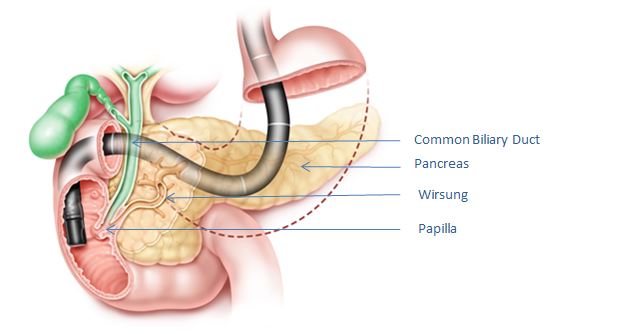
What is ERCP? Endoscopic retrograde cholangiopancreatography, or ERCP, is an endoscopic technique that is used to examine and treat problems in the bile and pancreatic ducts, and the gallbladder. The bile ducts are channels that drain bile from the liver and gallbladder; the pancreatic ducts drain the pancreas. Both types of ducts empty into the […]
Virtual Colonoscopy (CT Colonography)
FIBROSCAN

