



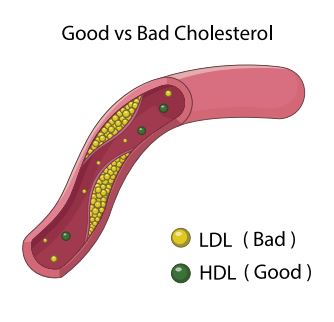
Two types of special proteins (lipoproteins) carry cholesterol to and from cells in your body. One is Low-Density Lipoprotein, or LDL. The other is High-Density Lipoprotein, or HDL. The amount of each type of cholesterol in your blood can be measured by a blood test.
LDL (BAD) CHOLESTEROL
LDL cholesterol is considered the “bad” cholesterol, because it contributes to fatty buildups in arteries (atherosclerosis). This condition narrows the arteries and increases the risk for heart attack, stroke and peripheral artery disease.
HDL (GOOD) CHOLESTEROL
HDL cholesterol can be thought of as the “good” cholesterol. So, in the case of HDL cholesterol, higher levels are actually better. Experts believe that HDL acts as a scavenger, carrying LDL (bad) cholesterol away from the arteries and back to the liver, where the LDL is broken down and passed from the body. But HDL cholesterol does not completely eliminate LDL cholesterol. Only one-third to one-fourth of blood cholesterol is carried by HDL.
A healthy HDL cholesterol level may protect against heart attack and stroke. Studies show that low levels of HDL cholesterol increase the risk of heart disease.
TRIGLYCERIDES
Triglycerides are the most common type of fat in the body. They store excess energy from your diet. A high triglyceride level combined with high LDL (bad) cholesterol or low HDL (good) cholesterol is linked with fatty buildups within the artery walls, which increases the risk of heart attack and stroke.
Related Articles
Related Articles
Abnormal Heartbeat (Arrhythmia)
What is an abnormal heartbeat? Abnormal heartbeat (whose medical name is arrhythmia) can be due to a variety of heart rhythm disorders. Abnormal heartbeat means that your heart beats too quickly, too slowly, or with an irregular pattern. When the heart beats faster than 100 bpm, it is called tachycardia. When the heart beats too […]
Atrial Fibrillation
Atrial Fibrillation (AF) is a common and serious disturbance of the electrical system of the heart. It is one of a number of conditions commonly referred to as ‘arrhythmias’ where the heart beats with an abnormal rhythm. If not recognised and correctly treated, AF can result in significant problems, including stroke and heart failure. HOW […]

Abnormal Heartbeat (Arrhythmia)

