




Surgeons at FV Hospital used the da Vinci Xi robotic surgical system to successfully remove a fibrous tumour located in a difficult-to-access area next to the aorta in a 46-year-old woman.
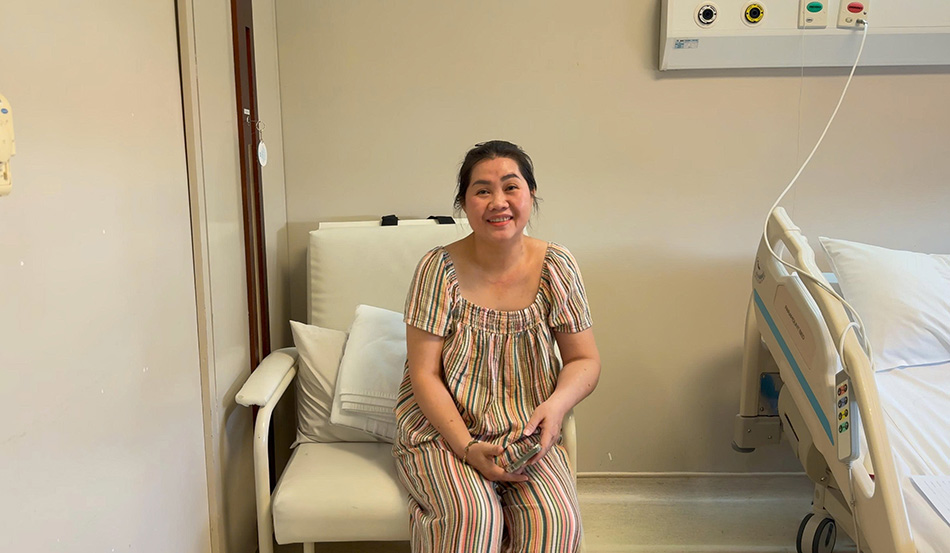
Ms Nguyen Thuy Phuong Dung recovered well after surgery to remove the fibrous tumour from her left chest. Image: FV
When a subtle chest discomfort reveals a hidden tumour
At 46, Ms Nguyen Thuy Phuong Dung (Ho Chi Minh City) regularly underwent health checks every six months. After experiencing mild discomfort in her left chest, she visited FV Hospital for an examination and was surprised when a chest CT scan revealed a tumour in her chest cavity. The tumour was located at the angle of the descending aorta, closely pressed against the heart and pulmonary artery. Its position was further complicated by being obscured by the ribs, shoulder blade, and pleura.
Dr Luong Ngoc Trung, MSc, Specialist Level II, Head of the Vascular Surgery and Endovascular Interventions Department and a specialist in thoracic and robotic surgery, explained: “Because the tumour was obscured by bony structures and lay directly adjacent to the aorta, we were unable to perform a percutaneous transthoracic needle biopsy to determine whether it was benign or malignant before surgery. Had we attempted this with conventional thoracoscopic surgery, accessing and manoeuvring within such a narrow, hidden angle between major blood vessels would have been extremely difficult.”
A 90-Minute procedure: removing a rare tumour adjacent to the aorta
Due to the challenging location of the tumour, the surgical team determined that robotic surgery with the da Vinci Xi system was the best approach.
Dr Trung noted that robotic surgery allows precise operation in confined spaces and at difficult angles. The robotic arms provide advanced articulation and high-definition imaging, enabling precise dissection around critical structures such as the aorta, pulmonary artery, and heart.
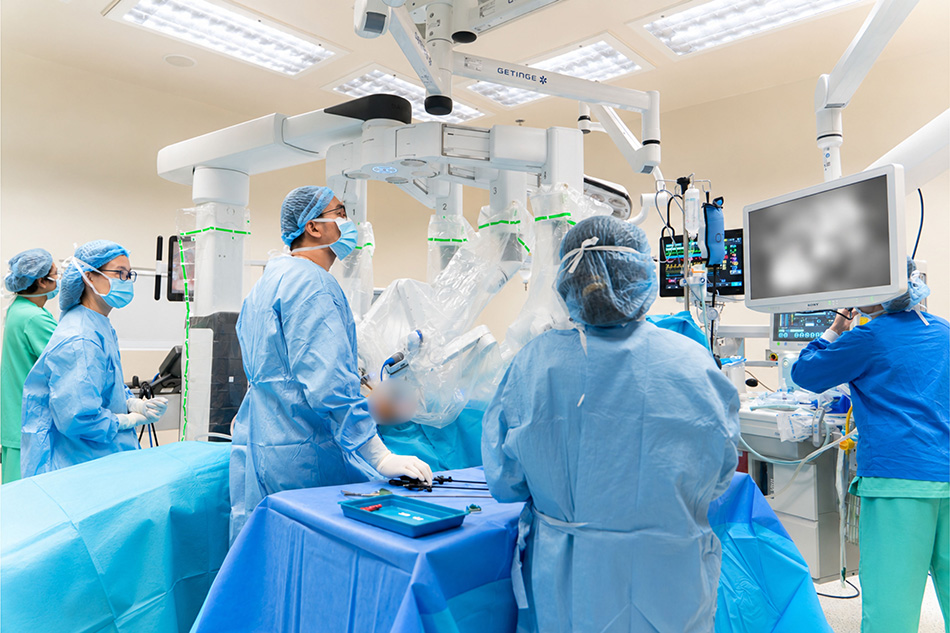
The FV Hospital surgical team dissected the tumour using the da Vinci Xi robotic system. (Image: FV)
In addition to its precision, robotic surgery minimises invasiveness, reducing damage to healthy tissue, decreasing post-operative pain, and shortening recovery time compared to traditional surgical methods. This benefit is especially important for lesions deep within the chest, where conventional access and manoeuvring are particularly challenging.
The surgical team, led by Dr Luong Ngoc Trung, successfully removed a tumour measuring 3.8 x 3 x 1.5 cm from the surface of the lung. The entire procedure, including complete tumour resection, was completed in 90 minutes from the time the patient entered the operating theatre.
After surgery, Ms Phuong Dung recovered smoothly. Two months later, she had resumed her normal activities, reported feeling about 90% recovered, and felt completely at ease.
“My health is back to normal, and I feel very reassured. Everything about this recent surgery went smoothly. I want to thank all the doctors, especially Dr Trung, for the successful operation,” Ms Phuong Dung shared, visibly moved.
Early intervention matters, even for benign solitary fibrous tumours
According to Dr Luong Ngoc Trung, MSc, MD, Specialist Level II, solitary fibrous tumour (SFT) is a rare neoplasm. While up to 80% are benign, about 20% may be malignant and are classified as a type of soft tissue sarcoma.
Even when confirmed as benign, if the tumour is not surgically removed, it will continue to grow. As it enlarges, it can compress nearby structures in the chest, causing complications and making future surgery more difficult.
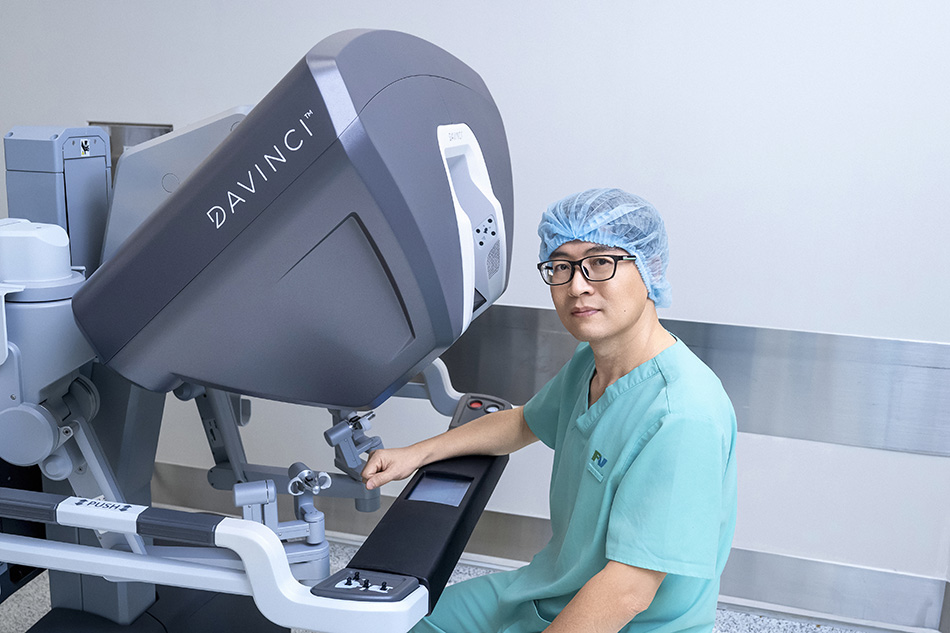
Dr Luong Ngoc Trung, MSc, MD, Specialist Level II, with the da Vinci Xi robotic surgical system. Image: FV
“This case illustrates the importance of early detection of small tumours located in technically difficult positions. Thanks to the support of the da Vinci Xi robotic surgical system, tumours located in narrow, hidden angles adjacent to major blood vessels, positions where conventional laparoscopic surgery is extremely difficult to perform and percutaneous biopsy is not possible, can now be treated completely and safely,” said Dr Luong Ngoc Trung.
Experts recommend regular health check-ups every six months to support early detection of abnormalities and timely access to modern medical care.
For more information on robotic surgery with the da Vinci Xi system at FV Hospital, please visit 6 Nguyen Luong Bang Street, Tan My Ward (formerly District 7), Ho Chi Minh City, or call (028) 3511 3333. Emergency Hotline: (028) 3511 3500.
Related News
See moreRelated News

Nutcracker Syndrome: How a one-hour stent placement ended a year of abdominal pain
FV Hospital successfully treated a complex case of nutcracker syndrome using minimally invasive endovascular stenting, sparing the patient major open surgery. Persistent abdominal pain linked to renal vein entrapment For over a year, 41-year-old Ms V.T.K.P. from Ho Chi Minh City experienced persistent, dull lower abdominal pain that worsened with prolonged sitting or standing. As […]
Abdominal pain misdiagnosed as digestive issue: 23-year-old woman diagnosed with ovarian torsion
While studying abroad in South Korea, N.T.T.M. (23) experienced unusual pain in her lower right abdomen. She sought treatment at a local hospital and received medication for a suspected digestive issue. After returning to Vietnam to visit her family, the pain recurred and worsened. On her friends’ advice, M. visited FV Hospital for evaluation. She […]
Boy with ‘boneless arm’ and decade-long journey to find hope
A jump at the age of six left young D.V.C. with devastating consequences: a left forearm almost entirely devoid of skeletal architecture, facing the prospect of limb amputation through joint disarticulation. For more than ten years, hope faded as every attempt at recovery stalled. It was only through the intervention of the Children of Vietnam […]
Travelling halfway across the world for specialist spinal stenosis treatment
A Canadian woman who had nearly lost the ability to walk due to spinal canal stenosis was successfully treated at FV Hospital and was able to return home just one week after surgery. More than thirty years ago, Ms M.C. (49, Canada) underwent scoliosis correction surgery. In the past year, she developed severe back pain […]
Nutcracker Syndrome: How a one-hour stent placement ended a year of abdominal pain
Abdominal pain misdiagnosed as digestive issue: 23-year-old woman diagnosed with ovarian torsion
Boy with ‘boneless arm’ and decade-long journey to find hope

